
Disaster risk reduction and management in Seychelles: how the system evolved, 1990s–2026
October 22, 2026

Seychelles’ disaster risk reduction and management system developed from a national committee in the 1990s into a legal, planning and coordination framework spanning government agencies, districts and response partners. Government initiated and led that institutional development. Later work added risk assessment, emergency planning, disaster risk financing, ecosystem-based adaptation and early-warning capacity, with documented support from international partners.
In UNDRR terminology, disaster risk reduction (DRR) aims to prevent new disaster risk, reduce existing disaster risk and manage residual risk—the risk that remains even when effective risk-reduction measures are in place. These aims contribute to stronger resilience and sustainable development. Disaster risk management (DRM) is the application of policies and strategies to achieve those aims, not only the organisation of emergency response.
Disaster risk depends on hazards, exposure, vulnerability and capacity; it is not simply the occurrence of a storm or flood. Resilience includes the ability of communities and systems to resist and absorb impacts, adapt and transform, and recover while preserving or restoring essential functions. This wider understanding connects the institutional history below to development choices, social vulnerability, ecosystems, preparedness and recovery.
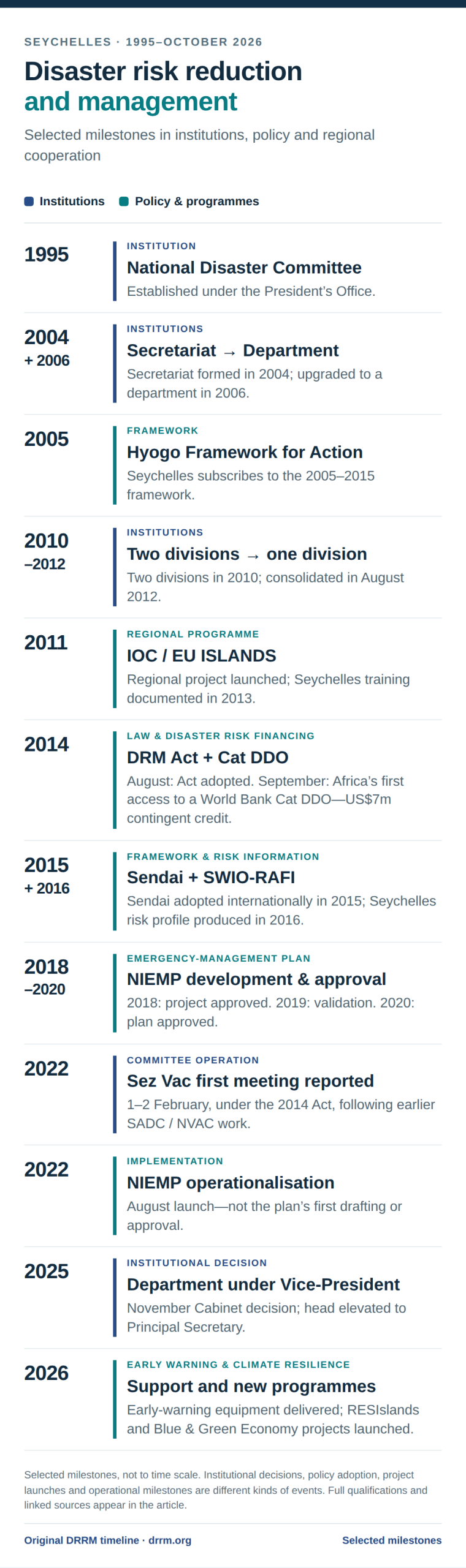
1990s–2006: a committee, a secretariat and a dedicated department
The National Disaster Committee (NDC) was established in 1995 under the President’s Office. This is recorded in the July 2008 Disaster Risk Profile of the Republic of Seychelles, a United Nations Development Programme (UNDP) report prepared by Denis Chang Seng and Richard Guillande and hosted by PreventionWeb. The 2013 Government of Seychelles Damage, Loss and Needs Assessment, hosted by the World Bank, corroborates the date and institutional location. The committee’s initial work included researching potential hazards and preparing a National Disaster Response Plan.
According to that assessment, a National Disaster Secretariat was formed two months before the December 2004 Indian Ocean tsunami, placing its formation in October 2004. The tsunami accelerated the move towards a dedicated office. By December 2006, the secretariat had been upgraded to the Department of Risk and Disaster Management, initially headed by a Principal Secretary assisted by a Director General. These were steps towards a standing government capacity, rather than arrangements activated only after an emergency.
2005–2012: the Hyogo framework and institutional reorganisation
The Hyogo Framework for Action 2005–2015, adopted internationally in January 2005, promoted a systematic approach to reducing vulnerability and disaster risk. The World Bank’s 2021 completion assessment records Seychelles subscribing to Hyogo in 2005 and describes it as a basis for the country’s later disaster-management legislation and policy. Seychelles also participated in the 2013–2015 Hyogo monitoring and progress review; reporting progress was not the same as completing every priority.
A regional vulnerability-assessment framework also developed during this period. SADC’s regional account dates the Regional Vulnerability Assessment Committee (RVAC) to 1999 and the Regional Vulnerability Assessment and Analysis (RVAA) programme to 2006. The programme supported government-linked National Vulnerability Assessment Committees (NVACs), helping vulnerability evidence inform development policy and emergency interventions.
Risk information became a practical part of the effort. A June 2008 report describes a completed risk-profile database developed through a survey funded by UNDP and the French government, with support from the national office. It mapped hazards and vulnerable infrastructure and communities, covering flooding, landslides, storms, tsunami and other risks.
The 2013 assessment, pages 33–34, records the office moving from the President’s Office to the Vice-President’s Office in 2009. In July 2010 it came under the Ministry of Environment and split into two divisions, each with a Director General: Policy, Planning and Risk Assessment (PPRM), as named in the assessment, and Operations, Education and Communication (OEC).
The World Bank’s 2012 country strategy identifies the National Disaster Preparedness and Response Project (P111474), covering capacity building, early-warning systems, emergency planning and national/community preparedness. It gives a US$900,000 grant and a closing date of 30 November 2011. A later World Bank country evaluation also lists it as a US$900,000 Trust Fund grant. The Bank’s FY10 trust-fund ledger records the recipient-grant agreement dated 27 August 2008 and, separately, a US$100,000 Bank-executed “Staff Costs” grant under the same project ID. These are two distinct grant allocations, not a single US$1 million grant received by Seychelles.
Seychelles also participated in the Indian Ocean Commission’s ISLANDS regional project, launched in August 2011 with European Union funding. Its disaster-risk strand supported national capacity for disaster-loss databases and risk assessment. A December 2013 UNDRR account documents Seychelles’ participation in regional training and database work with the IOC programme. The regional programme history connects this work to later risk-financing cooperation. These activities supported national preparedness and risk information.
In August 2012, the two divisions were consolidated into one Division of Risk and Disaster Management under a sole Director General, according to the 2013 assessment.
2013–2014: flood assessment, legislation and disaster risk financing
Flooding and landslides associated with Cyclone Felleng in January 2013 led to another national assessment of damage and recovery needs. GFDRR’s March–December 2013 technical assistance supported damage-and-loss assessment training, recovery planning and an institutional preparedness review. GFDRR records the assessment as a foundation for subsequent disaster-risk financing.
In August 2014, Seychelles adopted the Disaster Risk Management Act 2014, its first comprehensive disaster-risk-management legal framework. The IFRC’s account of the law explains that it designated the Division of Risk and Disaster Management as the national body and created the National Disaster Risk Management Committee, the Vulnerability Assessment Committee and the National Platform for Disaster Risk Reduction. It required disaster-management plans for government institutions and prescribed private organisations, established a national multi-hazard alert and warning system, and regulated international assistance. The World Bank completion assessment also records approval of the National Disaster Risk Management Policy in 2014. The legislation established responsibilities and legal powers; implementation developed over subsequent years.
In September 2014, Seychelles became the first African country to gain access to a World Bank Catastrophe Deferred Drawdown Option (Cat DDO), according to the World Bank’s contemporary announcement. The US$7 million IBRD-supported facility was a contingent loan, not a grant: it made credit available for rapid financing after an eligible emergency. In UNDRR’s framework, contingent credit is one way to manage residual risk alongside preparedness, response, recovery and social protection. It was linked to strengthening government disaster-management institutions and integrating risk into development planning. The Bank’s evaluation records renewal in 2017 and full drawdown in April 2020 following changes that enabled support for the COVID-19 emergency.
2015–2020: Sendai, risk-informed planning and adaptation
The Sendai Framework for Disaster Risk Reduction 2015–2030 was adopted internationally on 18 March 2015, succeeding Hyogo. Its four priorities are understanding disaster risk; strengthening disaster risk governance; investing in disaster risk reduction for resilience; and enhancing disaster preparedness for effective response and to build back better in recovery, rehabilitation and reconstruction. It became a benchmark for Seychelles’ subsequent emergency-management and national DRR planning.
National vulnerability-assessment arrangements developed alongside these reforms. SADC’s 2014–15 annual report records that an NVAC had been established in Seychelles. A July 2016 SADC RVAA-led workshop then supported development of the country’s vulnerability-assessment programme, including discussion of its national secretariat. These records show a national setup process preceding the later publicly reported operational committee.
The South West Indian Ocean Risk Assessment and Financing Initiative (SWIO-RAFI) added a regional technical-assistance strand. The World Bank/GFDRR regional summary traces its development to a 2012 request for World Bank support from the IOC ISLANDS/UNISDR platform. Financed through the EU-funded ACP–EU Natural Disaster Risk Reduction Programme and GFDRR, it supported Seychelles and other regional administrations with hazard, exposure and loss information, risk modelling and analysis of financial protection. Seychelles received a 2016 country risk profile. The profile provided a technical basis for risk-informed planning and financing choices.
Related World Bank/GFDRR-supported work included geospatial data, mapping and GIS/drone training. The 2021 completion assessment records Cabinet endorsement of the Coastal Management Plan 2019–2024 on 30 May 2019 and approval of the Spatial Data Sharing Policy on 6 May 2020. It also reports that five ministries had revised plans to incorporate risk information by 2020.
Climate adaptation developed alongside these institutional reforms. The Adaptation Fund’s ecosystem-based adaptation project was approved in December 2012 and began implementation in October 2014, with UNDP as implementing entity and the environment ministry as executing entity. It addressed water scarcity and flooding through watershed and coastal ecosystem measures. The Fund records the project as completed, with a revised completion date of March 2022. This adds an environmental strand to the history: reducing risk through land, water and ecosystem management, not only emergency response.
2018–2022: building integrated emergency arrangements
The National Integrated Emergency Management Plan (NIEMP) brought national, sectoral and district response arrangements into a shared framework. Its foreword records Cabinet approval of the development-and-implementation project in May 2018, followed by stakeholder validation workshops in August and September 2019. The document covers the 2019–2024 period and was circulated through a GFDRR record dated 2020. The World Bank evaluation separately records Cabinet approval of the plan on 26 August 2020, and its use during the COVID-19 response from March 2020, before that approval.
The August 2022 event was a launch of the plan’s operationalisation, not its first drafting or approval. World Bank technical assistance, supported by the Climate Risk and Early Warning Systems (CREWS) initiative, focused on training ministry and agency focal points and decision-makers, improving coordination and developing operating procedures and contingency plans. The plan’s development had also received World Bank technical support financed through GFDRR and European Union-funded ACP programmes.
A later operational milestone was the Seychelles Vulnerability Assessment Committee (Sez Vac). An 11 February 2022 report records the appointment of 13 officials under section 14 of the 2014 Act and the committee’s first meeting at a 1–2 February workshop with the SADC RVAA programme. Its work concerned vulnerability reduction, poverty-reduction and safety-net programmes relevant to disaster risk, hazard identification, and food and nutrition vulnerability. The statutory basis and regional/national preparatory work therefore preceded this reported operational milestone.
Institutional labels require care here. The 2021 Budget Book, page 283, calls the office a Department, whereas the 2022 operationalisation account calls it a Division. The sources reviewed do not establish a precise legal date or instrument for that change. The NIEMP’s departmental wording belongs to its preparation context and should not be used to assume unchanged status in later years.
2021–2024: a national strategy and closer links with climate planning
A 14 October 2021 national newspaper report documents work on the National Disaster Risk Reduction Strategic Plan 2021–2030. The UNDRR/PreventionWeb catalogue entry, dated February 2025, describes the plan as a ten-year roadmap aligned with Sendai and the 2014 Act. The planning period, evidence of drafting in 2021 and later catalogue publication are distinct; the catalogue does not establish the plan’s original approval date.
On 17–18 September 2024, a UNDRR-supported technical workshop developed a joint roadmap for integrating disaster risk reduction and climate-change adaptation. Germany’s development-cooperation ministry supported the work. Priorities included reviewing existing policies, capacities and data, developing a central risk database and improving coordination. These were agreed work priorities, not evidence that every action had been implemented.
2025–October 2026: early warning, data and further institutional changes
In July 2025, Seychelles, UNDP and China’s International Development Cooperation Agency launched the TIAEWS early-warning project. Its announced components covered information management, response coordination and communication reaching communities. The launch record places the disaster-management division under the Ministry of Internal Affairs. In July 2026, UNDP documented the handover of 35 tablets for field information gathering and sharing. That is a concrete implementation input, not proof that the full information and warning system was operational nationwide.
The 20 November 2025 Cabinet decision explicitly approved establishment and operationalisation of a department under the Vice-President, with its head elevated to Principal Secretary. The appointments effective 1 December 2025 reflected that structure. However, a 20 October 2026 presidential message again used “Division” under the Vice-President. That later wording alone does not prove another restructuring.
Two August 2026 launches extended the climate-risk programme. The Green Climate Fund-financed RESIslands readiness project, implemented by the UN Economic Commission for Africa with the African Island States Climate Commission, proposed work on risk information, institutional coordination and climate-finance pipelines. The GEF-8/UNDP Blue and Green Economy project began with inception planning for a seven-year programme that includes nature-based solutions and coastal-community resilience. As of October 2026, these launch records establish intended programmes, not completed resilience outcomes.
The chronology shows successive layers of work: institutions, legislation, risk information, financing, emergency arrangements and adaptation projects. Risk-informed planning and ecosystem measures address the prevention of new risk and reduction of existing risk; preparedness, contingent finance, response and recovery help manage the risk that remains. The history therefore extends beyond emergency response to the wider work of strengthening resilience. These are documented developments, while implementation and measured risk reduction remain separate questions. Keeping the distinction between what was drafted, approved, launched and delivered makes the historical record useful without claiming that the work is finished.