
Disability Inclusion in Disaster Risk Reduction: Practical Steps for Seychelles
October 22, 2026
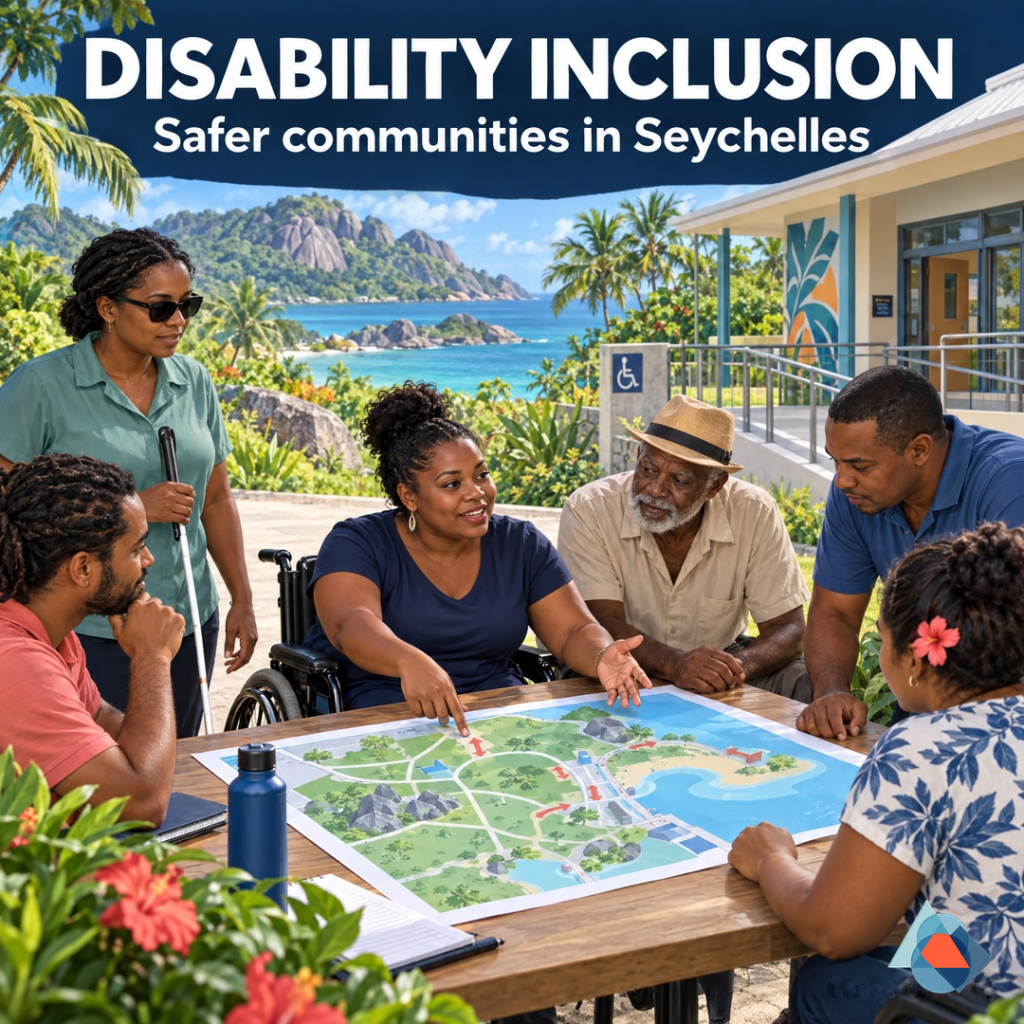
At the Development and Resilience Research Monitor (DRRM), we see disability inclusion as a practical part of safer disaster risk reduction (DRR) in Seychelles—not as an afterthought. A person’s impairment is not, by itself, vulnerability. Risk grows when hazards meet exposure and barriers: warnings that cannot be heard or read, transport and shelters that cannot be reached, services that exclude people, or decisions made without the people affected.
UNDRR terminology describes disaster risk through the interaction of hazards, exposure, vulnerability and capacity. Hazards are potentially damaging processes, phenomena or human activities; exposure concerns people and assets in hazard-prone places. Vulnerability reflects conditions that increase susceptibility to harm, while capacity includes strengths and resources for managing risk. DRR means preventing new risk, reducing existing risk and managing residual risk, all to strengthen resilience. That framing matters: persons with disabilities are not simply recipients of help. They are residents, professionals, community leaders and decision makers whose knowledge should shape risk assessments, plans, budgets and recovery.
1. Put lived experience into risk knowledge
Invite persons with disabilities and their representative organisations to map what could go wrong and what would help. Ask about access routes, communication preferences, support networks, service animals, medication, assistive devices and safe places—without collecting more personal information than is needed. Use voluntary, consent-based and privacy-respecting data practices, and explain who will use the information and why.
Seychelles’ national workshop on inclusive early warning systems validated a draft framework and capacity-building plan under the national Early Warning Systems Roadmap. The Inclusive Early Warning Systems Checklist offers a practical way to examine inclusion across warning systems; UNDRR also reports remaining gaps in involving at-risk groups in data collection. These are useful prompts for continued work, not evidence that every recommendation is already implemented. Read the UNDRR workshop report.
2. Make warnings usable by design
- Publish the same official warning in multiple, coordinated formats: plain language, readable text, audio, captions, sign-language interpretation and visual cues.
- Use high contrast, clear headings and easy-to-read versions; describe what is happening, where, when, what action is advised and when the next update will come.
- Test messages with people who have different access needs before an emergency. Do not assume one channel reaches everyone; combine trusted broadcast, phone, online and community routes.
- Credit and involve persons with disabilities as presenters, reviewers and sources—not only as subjects of a story.
A June 2025 Seychelles media workshop highlighted person-first, ethical reporting and accessible formats including captions, sign language and easy-read content. It also emphasized persons with disabilities as active participants. Those principles apply to public warnings as well as journalism. See the UNESCO workshop report.
3. Plan evacuation and support with consent
Work with disabled people to identify accessible routes, transport options, assembly points and shelter arrangements. Check entrances, toilets, sleeping areas, lighting, charging and communication. Assign trained support only where requested or agreed, and protect privacy: do not publish names, addresses or medical details to coordinate assistance. Plans should include people who may be isolated, as well as family members, carers and service animals, while respecting the person’s choices.
During an emergency, follow official warnings and instructions. If evacuation is advised, leave early using the safest available route and contact local emergency services or designated authorities for assistance. Do not enter floodwater or attempt an unsafe rescue. Never separate someone from essential mobility, communication or medical equipment without a safe, agreed alternative.
4. Protect continuity of medicines and devices
Before hazards occur, encourage personal preparedness plans that record essential medicines, prescriptions, clinical contacts, charging needs and backup power options. Store medicines and devices according to clinical and manufacturer advice, protecting them from water and heat while keeping them accessible. Ask a clinician or equipment provider about safe backup power; do not improvise medical repairs. Organisations can plan for accessible storage, charging and replacement pathways—but should not assume what a person needs. Confirm preferences directly and handle health information confidentially.
5. Make recovery accountable and inclusive
After an event, include persons with disabilities in damage assessments, relief design, rebuilding and lessons learned. Check whether temporary services, housing, schools, health care, livelihoods and public information are accessible. Track who is missing from consultations, remove participation barriers and pay people for specialist input where appropriate. Recovery is an opportunity to reduce existing risk and prevent new barriers—not to restore exclusion.
Inclusion works when it is built into ordinary risk governance before, during and after a crisis. Listen early, communicate accessibly, support autonomy and treat persons with disabilities as partners in strengthening Seychelles’ resilience.
Featured image: original AI-generated editorial illustration for DRRM; not a photograph of an actual event.