
Gender Inclusion in Disaster Risk Reduction: Practical Steps for Seychelles
October 22, 2026
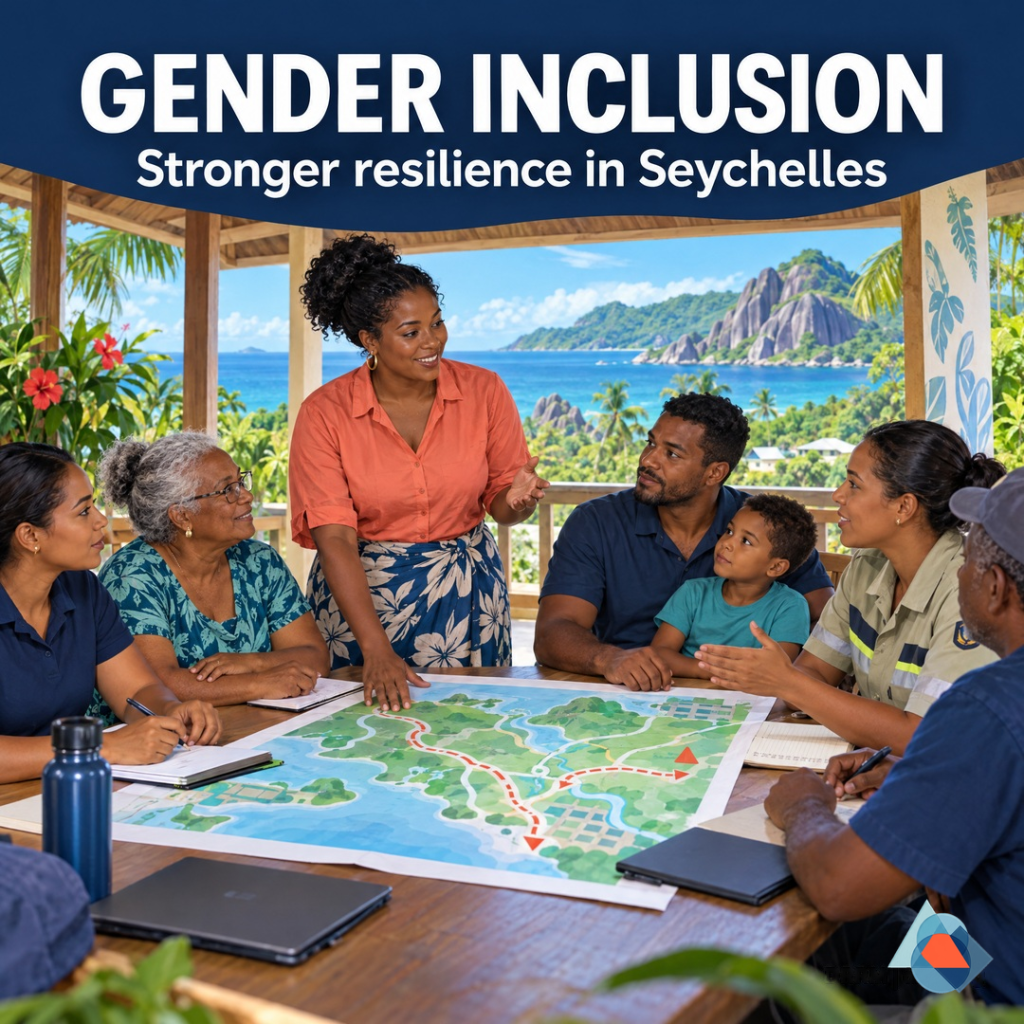
For the Development and Resilience Research Monitor (DRRM), gender inclusion is practical risk management, not a side issue. People of different genders can face different barriers to receiving warnings, leaving safely, protecting income or influencing decisions. But women are not automatically vulnerable, and men and boys are not automatically safe. Risk depends on context: who is exposed, what resources and choices they have, and whether institutions listen to their knowledge and leadership.
The United Nations Office for Disaster Risk Reduction (UNDRR) defines disaster risk as potential losses determined by hazard, exposure, vulnerability and capacity. A hazard is a potentially damaging process, phenomenon or human activity. Exposure is people, homes, infrastructure and livelihoods located in hazard-prone areas. Vulnerability is the physical, social, economic or environmental conditions that increase susceptibility. Capacity is the strengths, skills, relationships, institutions and resources available to manage risk and strengthen resilience. Gender inequalities can shape these conditions, but so can disability, age, health, income, caregiving, language, isolation and many other factors.
Disaster risk reduction (DRR) therefore has three connected aims: preventing new risk, reducing existing risk and managing residual risk—the risk that remains even after effective measures. Gender-responsive DRR improves all three by finding barriers early and strengthening agency, leadership and collective capacity. UN Women recommends integrating gender into prevention, preparedness and recovery, while supporting women’s leadership, access to early warnings, finance, resilient infrastructure and livelihoods. This is not a claim that all women share one experience; it is a reason to ask whose needs and decisions are missing.
What inclusive planning can look like in Seychelles
Start with local risk knowledge. District and community planning teams can map hazards, exposure, services and routes with residents, women’s organizations, people with disabilities, youth, older people, fishers, farmers, employers and care providers. Collect voluntary, safe, disaggregated information and explain how it will be used. Do not treat participation as consultation after decisions are made: include diverse residents in setting priorities, testing plans and reviewing what worked. Seychelles’ national workshop on inclusive early warning systems validated a draft framework and capacity-building plan under the national EWS roadmap; its checklist covers gender and disability, while the workshop identified gaps in inclusive risk knowledge and in involving at-risk groups in data collection (UNDRR, “Building inclusive early warning systems in Seychelles”).
Design warnings for real lives. Use more than one channel and repeat clear instructions in accessible formats and languages people use. Test whether messages reach people who are working, caring for children or older relatives, living alone, away from a phone, or unable to hear, see or travel easily. Ask communities which messengers they trust. Plan for two-way feedback so residents can report blocked routes, missing information or changing conditions. Warnings should tell people what to do, where to go and when to act—not simply announce a hazard.
Make evacuation and shelters safe and dignified. Plans should identify accessible transport, assistance for people with mobility or communication needs, space for families and caregivers, and privacy for changing clothes, breastfeeding and personal care. Stock menstrual and essential health supplies without stigma, and set confidential ways to report harassment, violence or other protection concerns, with trained personnel and clear referral pathways. These are planning recommendations, not assumptions that any current shelter already provides them. Everyone should follow official warnings and never enter floodwater: it may hide swift currents, debris, contamination or open drains.
Recognize care, work and recovery. Preparedness exercises should ask who can leave work, who will care for dependants and who controls transport, documents, savings and communication devices. Recovery programmes can offer information, flexible access, safe work opportunities and finance to people whose livelihoods are disrupted, while avoiding stereotypes about “men’s work” or “women’s work.” Track who receives assistance and who is left out, with privacy safeguards. Include men and boys in prevention, caregiving and positive leadership, and include LGBTQI+ people and others whose needs may be overlooked without making unsupported assumptions about their circumstances.
Gender inclusion is strongest when it changes power as well as checklists. Seychelles’ Universal Periodic Review report records that the country launched a National Gender Policy in 2016 with thematic areas, goals and objectives for gender equality and gender mainstreaming. DRR practitioners can connect that policy direction to measurable local action: representative planning groups, accessible warnings, safe facilities, confidential accountability and equitable livelihood recovery. Resilience grows when people are treated as decision-makers and capacity-holders—not as categories.
Featured image: original AI-generated editorial illustration for DRRM; not a photograph of an actual event.