
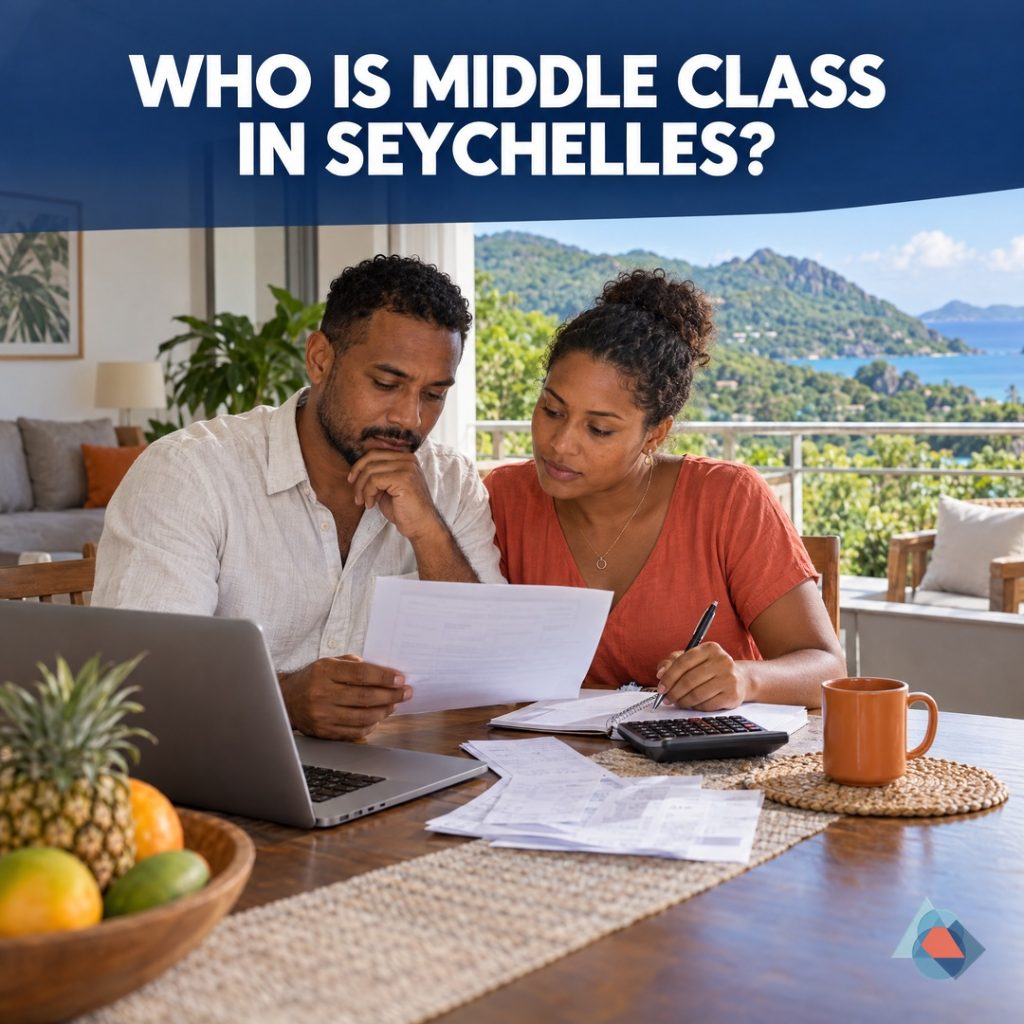
The Development and Resilience Research Monitor (DRRM) turns next to a label used constantly but rarely defined: “middle class”. In Seychelles, it can describe a salary, a lifestyle, a sense of security or a place in the income distribution. Those are related, but they are not the same thing.
No official Seychelles middle-class line was identified in the reviewed NBS releases
Seychelles’ National Bureau of Statistics (NBS) publishes household and social statistics, including a Poverty Profile for 2017–2018, Household Budget Survey material and a Poverty and Equity Assessment [NBS social statistics]. These sources help measure welfare and inequality. They do not, however, create a single official legal or statistical category called “middle class”. A responsible article must not turn a convenient rule of thumb into a government threshold.
International researchers often define a middle-income group relatively, for example as households between a lower and upper multiple of median equivalised disposable income. Researchers can choose a stated band around the median for a particular study. DRRM does not assign a Seychelles cut-off here: any such band would be an editorial convention, not an NBS definition, until a source and purpose are specified.
Why the median and the household unit matter
The median is the point at which half of people or households are below and half above. Unlike an average, it is less pulled upward by a small number of very high incomes. But the choice of unit changes the answer. A household’s total income must be adjusted for the number and ages of its members, because two adults with no children and two adults supporting three children face different costs. This is called equivalisation.
Disposable income also means something specific: money available after direct taxes and including relevant transfers, depending on the survey design. A gross salary, take-home pay and household consumption are different variables. A household can sit in the middle of the income distribution while spending little because it is saving, or spending more because it is drawing down assets or receiving help. Any Seychelles middle-class estimate should therefore state whether it uses gross or disposable income, income or expenditure, people or households, and which survey year and price base.
Middle income is not the same as middle-class security
A middle-class life is often described through practical capabilities: stable work, a tolerable home, reliable transport, access to education and healthcare, some ability to save and a buffer for an unexpected bill. Those capabilities depend on wealth and risk as well as current earnings. A household renting an expensive home with irregular work may have a middle income in a good month but little protection. Another household with a modest wage and a paid-off home may have greater security.
For a small island economy, prices and choices also shape the experience. Imported food, fuel, construction materials and services can make a nominal income feel different from the same amount elsewhere. Comparing Seychelles directly with a larger country without purchasing-power and household-composition adjustments can mislead. A country-level “high income” classification is about average national income; it does not tell us where an individual household sits.
What the available evidence can—and cannot—say
The World Bank says its Seychelles poverty and inequality indicators are based on primary household survey data obtained from government statistical agencies, with several series shown through 2018 [World Bank Seychelles indicators]. The African Development Bank’s 2025 country diagnostic reports a Gini index of 32.1 for 2018, while discussing strong social access alongside continuing labour-market and cost pressures [AfDB Seychelles Country Diagnostic Note]. The Gini measures inequality; it does not identify who is middle class or how much income that group needs.
Public reporting has described the NBS Household Budget Survey 2024–2025 as the survey intended to update evidence on income, expenditure and consumption. As at 23 October 2026, DRRM does not treat fieldwork or a secondary report as a published new middle-class threshold. The eventual release may change the distribution, the median and the prices behind any relative calculation.
A useful definition for readers
DRRM uses “middle class” in Seychelles as an analytical description for households around the middle of the equivalised disposable-income distribution that also have reasonable access to essential services and some capacity to absorb ordinary financial shocks. The first part can be measured. The second needs indicators, not assumptions.
That definition deliberately allows a household to be income-middle but financially fragile. It also avoids treating home ownership, a particular job or consumption style as a moral badge. In practice, a good national dashboard would show the income band, housing costs, employment stability, debt, savings and access to services separately. It would report medians and ranges, not pretend that one rupee cut-off captures every family.
So, when someone asks whether Seychelles is becoming more middle class, the follow-up should be: middle by which measure, in which year, adjusted for whom, and secure against what? Those questions make the label more useful—and make the public conversation more fair.
Updated 23 October 2026. No official Seychelles middle-class threshold was identified in the reviewed NBS releases.