
Does Seychelles Need More NGOs? The Better Question Is Where Capacity Is Missing
October 23, 2026
Development and Resilience Research Monitor (DRRM) | 23 October 2026
“Seychelles needs more NGOs” sounds positive, but it can mean several things: more voices in public decisions, more organisations delivering services, more volunteers, or more independent scrutiny of government and business. Those are not interchangeable. The evidence supports a stronger civil society ecosystem, but it does not support claiming that a particular service is absent without checking the responsible provider, location and eligibility rules.
What NGOs can add
Non-governmental organisations can reach people through trust, lived experience and specialist practice. They may pilot a service, represent a group whose needs are easy to miss, monitor public commitments, or connect island communities to regional expertise. An organisation focused on disability, youth, safety, environment or consumer rights can make a policy problem visible.
Seychelles’ open-government review shows why this voice matters. The independent Open Government Partnership review says the 2023–2025 action plan was co-created by government and civil society, and records civil-society lobbying as a factor that helped secure the second plan. It also identifies fisheries transparency and constitutional knowledge as areas where broader participation can improve governance (OGP Seychelles Action Plan Review). These are accountability and participation roles, not substitutes for a ministry or a licensed professional.
What government must still own
Government remains responsible for rights, public money, regulation and essential services. A ministry cannot transfer its duty to protect people simply because a charity is willing to help. The state must set standards, fund core provision, publish performance information, regulate safeguarding and ensure that access is fair across islands and income groups. It should also avoid contracting NGOs without a clear outcome, referral pathway, data-protection rule and renewal decision.
An official message from the Office of the President makes the principle explicit: government ministries and agencies, the private sector and civil society must join forces to address social ills, while social workers help individuals and communities. The statement is from 2011, so it is not evidence of today’s service inventory, but it remains a clear description of shared responsibility (Office of the President, Social Work Day message). Partnership should mean defined roles, not an assumption that volunteers will fill every gap.
Where private business fits
Businesses provide jobs, products, infrastructure and professional expertise. They should meet labour, consumer, environmental and accessibility obligations regardless of whether an NGO is active. Companies can support community work through transparent grants, skills and responsible procurement, but philanthropy is not a replacement for tax-funded services or enforcement. Public-private partnerships need open contracts and measurable public value, especially where a company is both provider and sponsor.
More NGOs is not automatically more capacity
New organisations can widen representation, but fragmentation can also dilute scarce staff, duplicate projects and make it hard for a person in need to know where to go. Small organisations may depend on one founder, short grants or unpaid labour. They can have strong local knowledge but weak bookkeeping, safeguarding, monitoring or continuity. Larger organisations may have systems but miss a neighbourhood or a minority voice. The answer is not to rank one model as best.
Capacity support should be practical: shared finance and legal services, training in safeguarding and data protection, multi-year grants for core operations, accessible reporting templates, and referral directories that are kept current. Funders should pay for coordination and evaluation. NGOs should publish who they serve, what they can actually offer, how complaints are handled, who governs them, and whether an independent financial review is available. That is accountability to beneficiaries as well as donors.
A cautious reading of the evidence
UNDP’s 2024 Seychelles annual report describes progress in education, health and poverty reduction while also noting inequality, tourism dependence and limited growth. It presents partnerships, digitalisation and inclusion as part of the country’s development work (UNDP Seychelles 2024 Annual Report). Those broad pressures justify asking whether civil-society capacity is adequate. They do not prove that any named service is missing, that NGOs are failing, or that more organisations alone will solve a problem.
The OGP review supplies a more specific warning: Seychelles’ action plan benefited from collaboration, but stakeholders also raised the limited co-creation timetable, budget constraints and lack of defined administrative structures for continuity. Its recommendation to formalise the multi-stakeholder forum and resource institutional memory is a useful capacity lesson. Accountability needs time, staff and records, not only invitations to a meeting.
A practical test
Before creating or funding another NGO, map the need by island and population. Ask who is responsible now, what standard applies, how many people are waiting, and whether the barrier is money, staff, transport, information or trust. Then test the least duplicative option: improve an existing organisation, commission a time-limited pilot, create a government service, or support a new independent group. Publish the decision and review it.
So does Seychelles need more NGOs? It likely needs more capable, accountable and representative civil-society capacity in selected fields, not a promise that more registered entities will fix every gap. Government must remain answerable for essential services and regulation. Business must meet its obligations. NGOs should add reach, expertise, participation and scrutiny—and be given the stable support and transparent standards needed to do those jobs safely.
References
Open Government Partnership Seychelles Action Plan Review 2023–2025; Office of the President message on social work; UNDP Seychelles 2024 Annual Report. Sources checked 23 October 2026. No claim of service absence is made without a current service-level source.
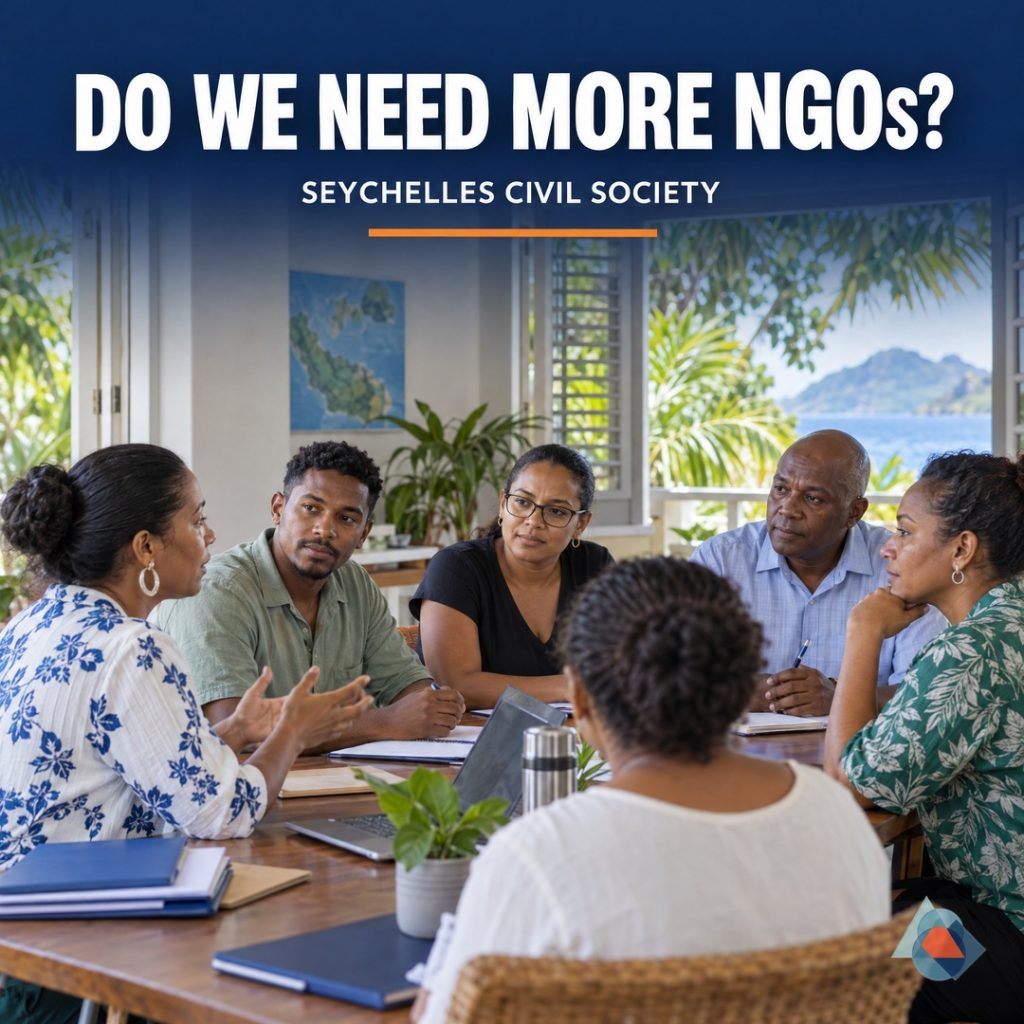
Image: original AI-generated editorial illustration for DRRM. People and settings are illustrative, not a documentary photograph of a real household, workplace or event.