
Childcare, care responsibilities and the ability to earn
Affordable childcare is not only a family expense. It can shape whether a parent can accept a job, keep regular hours, study or start a small income-earning activity. In Seychelles, the public evidence now shows a policy response and some efforts to expand registered provision. It does not yet show how many families receive help, whether the help matches working hours, or whether parents’ employment and earnings have changed.
What the latest labour data show
The National Bureau of Statistics’ Labour Force Survey for April to June 2026 reports an employment-to-population ratio of 63.6% for people aged 15 and over. The ratio was 64.7% for men and 62.5% for women. The same bulletin reports an overall unemployment rate of 3.2%, calculated among people in the labour force, and youth unemployment of 14.1% among 15–24-year-olds. These are useful measures of labour-market position, but they do not explain why people are employed, unemployed or outside the labour force. In particular, the sex gap is not evidence that childcare caused it. NBS Labour Force Survey Q2 2026
Care is also broader than childcare. Parents may be balancing school-age supervision, eldercare, disability care, household work and paid work. The LFS does not provide a national time-use measure that separates these responsibilities or estimates how they affect hours, job retention or income. That missing information matters before any policy is judged.
A new assistance measure, but an incomplete picture
The 2026 Budget Speech provides an additional SCR 3.0 million for childcare assistance. From 1 February 2026, the first phase offers SCR 750 a month to parents with a net salary of up to SCR 8,555.50. The budget records the policy and its threshold; it does not by itself establish how many parents have enrolled, how quickly payments are made, how many months a family can receive support, or whether the amount covers a meaningful share of fees. 2026 Budget Speech
The Institute of Early Childhood Development’s April 2025 update gives a more concrete, but still limited, supply picture. It says 121 home-based providers were registered, 86 were approved to take two additional children and 19 could take one more, for a reported 191 extra places. The change allowed up to 12 children in a home-based service where space and staffing requirements were met. This is an administrative expansion of potential registered capacity, not a national inventory of all places, a measure of vacancies or proof that families can find care close to home and at the hours they need. IECD home-based quota update
Registration and quality are part of access, not a substitute for it. IECD states that people providing childcare at home or in a centre must be registered under the Early Childhood Development Act 2022. In 2025, it also launched an early-stimulation and learning programme for registered home-based providers serving children from four months to three years. That programme addresses learning materials, training and practice. It does not report the price, opening hours, waiting time or geographic distribution of care for households. IECD registered-provider information IECD early-stimulation programme
A separate April 2025 IECD release described a proposed childcare facility on Praslin linked to a hotel workforce and the wider community. The proposal is evidence of identified demand and planning activity. It is not evidence that the facility has opened, how many places it provides, or whether it has reduced recruitment or commuting difficulties. IECD Praslin facility proposal
What would make the policy testable
A stronger public dashboard would connect the assistance budget to delivery. It could report applications, approvals, payments, average processing time, participating providers and unused or filled places. It should show fees and hours by island and child age, while protecting family privacy. A place that closes before a parent’s shift ends is not equivalent to a place that covers the full workday. A subsidy that is available only after a parent has secured a registered place may also leave families in areas with few providers behind.
The most useful outcome measures would follow parents over time. They could include changes in paid hours, job retention, return after parental leave, study participation and household earnings. Results should be broken down by island, income, child age and type of care where sample sizes permit. This would not prove that every employment change came from childcare, because wages, transport, health, housing and employer practices also matter. It would, however, give policymakers a way to test whether assistance is reaching the barrier it is intended to address.
For Seychelles, the priority is a local evidence base rather than an overseas estimate of childcare’s effect on women’s employment. A properly designed household or time-use module could record unpaid care, paid work, hours, service use and costs together, while administrative data could show whether assistance translates into usable places.
The practical policy question
Seychelles has taken identifiable steps: a targeted SCR 750 monthly assistance measure, registration rules, a temporary expansion of home-based quotas and quality support for providers. The next question is delivery. Are places available where families live? Do opening hours match tourism, health, education and other shift work? Does the assistance reach low-income parents who need it, and is the amount enough after fees and transport? Do parents stay in work or increase hours when care becomes usable?
Those questions are not arguments against the policy. They are the information needed to improve it. Until the country publishes a childcare supply-and-demand inventory, parent-level take-up and outcome data, the careful conclusion is that Seychelles has expanded the policy framework and some registered capacity, while the effect on work and incomes remains unmeasured.
- NBS Labour Force Survey Q2 2026, released 30 September 2026; data April–June 2026.
- Government of Seychelles 2026 Budget Speech, published 12 February 2026; budget year 2026.
- IECD home-based childcare quota update, published 10 April 2025; administrative information as of April 2025.
- IECD registered-provider information, accessed 24 October 2026; registration framework.
- IECD early-stimulation programme, published 26 May 2025; programme launch and 2025 implementation.
- IECD Praslin childcare facility proposal, published 17 April 2025; proposal stage.
Sources
- NBS Labour Force Survey Q2 2026 — 30 September 2026; data period: April–June 2026.
- Government of Seychelles 2026 Budget Speech — 12 February 2026; data period: 2026 budget year; childcare measure from 1 February 2026.
- IECD Announces Changes to Child Quota for Home-Based Child Care Services — 10 April 2025; data period: Administrative position as of April 2025.
- IECD List of Registered Childcare Managers and Childminders — Not stated; accessed 24 October 2026; data period: Registration framework current on access date.
- IECD Launches the Early Stimulation and Learning Programme for Home-Based Child Care Services — 26 May 2025; data period: Programme developed/piloted before and implemented during 2025.
- IECD Welcomes New Child Care Facility Investment Plan on Praslin Island — 17 April 2025; data period: Proposal discussed 15 April 2025.
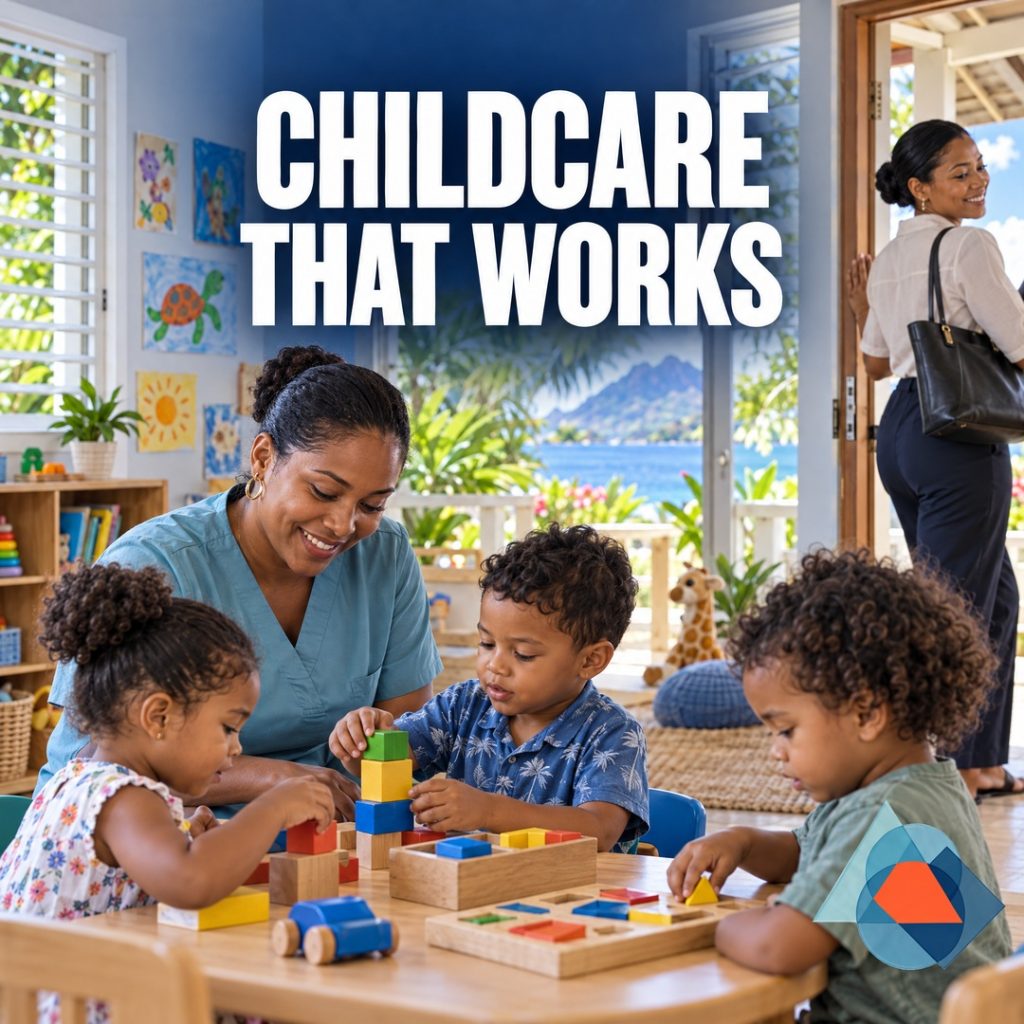
Image: original AI-generated editorial illustration for the Development and Resilience Research Monitor (DRRM). People and settings are illustrative, not a documentary photograph of a real household, institution or event.