
Public transport, commute costs and access to opportunity
Public transport can determine whether a person can reach a job, school, clinic or public office on time. In an island economy, the question is not simply whether a bus fare has changed. It is whether a household can afford the trips it needs, whether services run when they are needed, and whether a missed or delayed journey carries a cost in lost pay, missed classes or postponed care.
What current figures do—and do not—tell us
The National Bureau of Statistics’ September 2026 Consumer Price Index recorded year-on-year transport inflation of 4.84%. The all-items inflation rate was 1.22%. CPI measures the movement of prices in a fixed basket. It does not show the share of a household’s income spent on bus travel, how many trips people make, or whether service quality has improved or deteriorated. A higher transport sub-index is therefore a signal to investigate, not a measure of fare burden. NBS CPI September 2026
The August 2026 Mid-Year Economic and Fiscal Outlook reports that SCR 27.6 million had been transferred to the Seychelles Public Transport Corporation by the end of June. It also lists a 2026 revised capital budget for SPTC of SCR 30.086 million, with SCR 10.893 million spent by June. These are public-finance and spending figures. They do not reveal the cost per passenger, the operating deficit, route-level reliability or the benefit received by different income groups. 2026 Mid-Year Economic and Fiscal Outlook
Service exists, but reliability needs measuring
SPTC’s July 2026 weekday timetable shows a wide route network organised by route and direction. It tells passengers where scheduled services are intended to run and provides estimated times. The document explicitly warns that times may vary with traffic and operating conditions. A timetable is therefore an access plan, not proof that buses arrive at every listed time or that a passenger can complete a connection within a workable window. SPTC weekday timetable, effective July 2026
The same distinction applies to coverage. A route passing near a settlement does not establish that the first bus is early enough for a shift, that the last bus serves workers returning late, or that a person with a disability can use the service. Those questions require observed departure and arrival data, waiting times, cancellations, crowding, vehicle accessibility and the distance between stops and destinations.
The latest located national comparison in the 2025 Voluntary National Review is an older baseline for selected transport indicators. It should not be presented as 2026 ridership or current route performance. The public record reviewed for this article did not provide a current, route-level series linking ridership, on-time performance, missed trips and passenger income.
Measuring affordability from the household’s point of view
A fare can be low in absolute terms and still be difficult for a household that needs several trips each day. A parent may make separate journeys for work and school collection. The relevant measure is the cost of required trips compared with disposable income and other essential spending.
The World Bank’s transport-survey guidance offers a useful method rather than a Seychelles result. It recommends collecting transport spending by category and examining differences by income group and place of residence. It also shows why recall periods, household size and consistent definitions matter when annualising expenditure. For Seychelles, a practical indicator could compare the monthly cost of regular public-transport trips for lower-income households with household income, while separately recording trips that are not made because of cost. World Bank transport household-survey guidance
That information is not available in the current CPI or MYEFO figures. Nor should a subsidy transfer be treated as proof that fares are affordable. A public transfer may help sustain service, but its household effect depends on fares, frequency, routes, eligibility and who uses the buses.
Access is an outcome, not just a route map
Transport policy should track what people can reach. Useful measures include the time and money needed to reach major employment areas, schools and health facilities; the number of trips requiring a transfer; average and worst waiting times; and the frequency of missed work, classes or appointments after a service disruption. Results should be separated by island, income, age and disability where data allow.
This would also improve decisions about universal and targeted support. A universal fare subsidy is simple and may protect regular users, but some public money may go to passengers who would travel anyway. A targeted concession may direct more support to low-income riders, students or people with disabilities, but it can add application and enforcement costs. Neither approach should be selected from CPI movement alone. The test is how much reliable access each SCR buys and whether the people facing the greatest barriers receive it.
Operating data matter as much as fare policy. The MYEFO transfer and SPTC capital spending can support vehicles, staff, fuel, maintenance or infrastructure, but the documents do not connect each rupee to passenger outcomes. A stronger public report would show completed trips, cancellations, breakdowns, passenger loads, maintenance costs and route-level cost per passenger.
A fair test for the next phase
Seychelles has current timetables and a substantial public financial commitment to SPTC. It also has a current price signal showing that transport prices rose faster than the all-items CPI in September. Those facts establish why affordability and reliability deserve attention, but they do not establish that commuters face an excessive burden or that routes are failing.
The next evidence step is straightforward: combine household expenditure and income data with SPTC’s route, ridership, punctuality and operating-cost records. Ask passengers how often they wait, miss a connection or change a trip because of cost. Publish results by island and user group. That would allow policymakers and the public to judge whether universal support, targeted assistance, more frequent services or better maintenance offers the greatest access per SCR.
Until that linked dataset is available, the balanced conclusion is limited but useful. Seychelles has a live public transport network, current schedules and significant state support. The national evidence still cannot quantify the fare burden on different households or the reliability of the journeys on which work and essential services depend.
- NBS Consumer Price Index, September 2026, released 7 October 2026; price data September 2026.
- Government of Seychelles Mid-Year Economic and Fiscal Outlook 2026, published October 2026; fiscal data through June 2026.
- SPTC weekday timetable, effective July 2026, published/posted 2026; scheduled weekday services and timetable caveat.
- Seychelles 2025 Voluntary National Review, published 2025; selected older transport baselines, not a 2026 ridership series.
- World Bank, Improving Multi-Topic Household Surveys for Better Transport Policy Analysis, published 2022; comparative measurement method, not a Seychelles estimate.
Sources
- NBS Consumer Price Index September 2026 — 7 October 2026; data period: September 2026.
- Government of Seychelles Mid-Year Economic and Fiscal Outlook 2026 — October 2026; data period: Fiscal and spending data through June 2026.
- SPTC Weekday Timetable, Effective July 2026 — 2026 (posted August 2026); data period: Weekday scheduled services effective July 2026.
- Seychelles 2025 Voluntary National Review — 2025; data period: Selected indicators generally ending 2023 or earlier.
- Improving Multi-Topic Household Surveys for Better Transport Policy Analysis — 2022; data period: Comparative survey-method research.
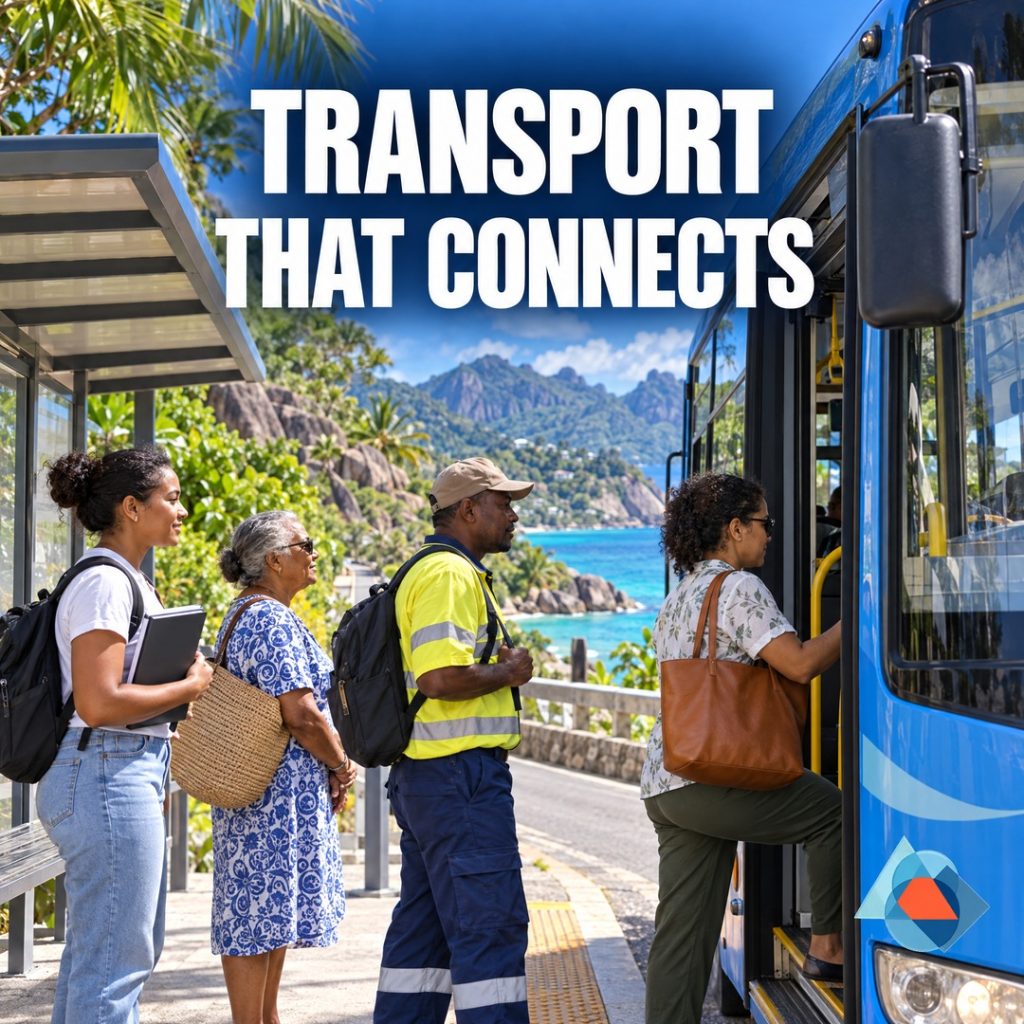
Image: original AI-generated editorial illustration for the Development and Resilience Research Monitor (DRRM). People and settings are illustrative, not a documentary photograph of a real household, institution or event.