
Electricity affordability, renewables and energy security
Seychelles has a clear reason to reduce its dependence on imported fuel: the country’s electricity system is exposed to international prices, shipping conditions and foreign-exchange pressures. In the first six months of 2026, mineral fuels accounted for 23% of import value, and their value was 28.2% higher than in the same period of 2025. Those figures describe the import bill, not the share of electricity generated from fuel, but they show why energy policy is also household and economic policy. NBS Merchandise Trade, Q2 2026
What the latest evidence actually shows
The World Bank’s 2025 launch of the Seychelles Renewable Energy Acceleration Program reports that imported fossil fuels supplied more than 95% of electricity and that renewables supplied 5% of total generation in 2023. The national target is 15% renewable energy by 2030. The 5% figure is a dated 2023 baseline. The 15% figure is a target. Neither is evidence of the 2026 generation mix or of progress already achieved. World Bank, 30 June 2025
The latest PUC annual report located for this review covers 2023. It records 23.37 gigawatt-hours of renewable production, equal to 4.92% of total electricity production. Solar, wind and rooftop photovoltaic systems all contributed. PUC also reported 45,364 electricity customers and consumption of 424.7 million kilowatt-hours that year. These are useful operating baselines, but they do not substitute for a 2024, 2025 or 2026 operating report. PUC Annual Report 2023
The same report shows why renewable expansion is not only a question of installing panels. PUC says the 15% target would require at least 8 megawatts of additional solar photovoltaic capacity each year from 2024. It also identifies limited land, the intermittent nature of solar power, the need for battery storage and careful grid integration. In 2023, the wind farm’s reported availability was 88.4%, with one turbine down for maintenance for most of the year. That is not proof that renewables are unreliable. It is evidence that maintenance and system design matter to the value of renewable capacity.
Bills, tariffs and who pays
Affordability cannot be read from a single tariff number. A bill depends on consumption, household size, appliances, business activity and the tariff structure. A current national series showing electricity bills as a share of household income was not identified in the reviewed public sources.
PUC’s 2023 report says average electricity tariffs fell by 32 cents per kilowatt-hour in 2023, while electricity revenue fell from SCR 1.7 billion in 2022 to SCR 1.66 billion. The report attributes the tariff movement mainly to a SCR 1.54-per-litre fall in weighted average fuel prices. It also says PUC had undertaken a 2023–2027 tariff analysis because of rising costs, debt repayments, maintenance and employee expenses, and that an increase was agreed for 2024. A lower tariff can help customers at the meter while shifting pressure to the utility’s cash position, future capital spending or public support. Calling it “cheaper” requires showing who bears the cost and whether service quality is protected.
The September 2026 Consumer Price Index offers a narrow but current price signal. The housing, water, electricity and gas group fell 0.24% month-on-month. CPI measures movement in a fixed basket; it does not show whether electricity is affordable for a particular household or what proportion of income the bill consumes. NBS CPI, September 2026
The 2026 policy offer
The 2026 Budget proposes SCR 5.7 million for rooftop solar on government buildings in 2026 and SCR 10 million in 2027. It also allocates SCR 12 million to a Green Energy Incentive Scheme for households and small businesses installing grid-connected rooftop systems. The budget says the measures should lower bills, reduce reliance on imported fuel and improve energy security. These are policy aims, not measured outcomes. The public case will be stronger when implementation reports show how many systems were installed, who benefited, the energy produced, maintenance costs and whether support reached customers who could not finance an installation themselves. 2026 Budget Speech
The World Bank-backed Renewable Energy Acceleration Program is a seven-year, US$35 million operation involving grid modernization, storage, regulatory reform and technical assistance. The 2026 Budget says it will support higher renewable penetration across Mahé, Praslin and La Digue. Financing and technical assistance can make projects possible, but they are not the same as completed assets, reliable output or lower bills. Those outcomes need regular reporting.
A practical test for energy security
A resilient transition should be judged on several measures together. Households need bills they can manage. Small businesses need predictable supply. PUC needs enough revenue to maintain generators, networks and storage. Government needs to disclose any subsidy or guarantee that keeps tariffs below cost. The system also needs data on outage duration, arrears, battery performance, renewable output and island-level service.
The direction is sensible: diversify the energy mix while strengthening the grid. The difficult question is distribution. Who receives rooftop support? Who pays for storage and network upgrades? How are customers protected if fuel prices rise before renewable savings arrive? Until those questions are answered with current operating and financial data, Seychelles should describe renewable expansion as a transition under implementation—not as a completed affordability or energy-security result.
Sources
National Bureau of Statistics, Merchandise Trade, Q2 2026. National Bureau of Statistics, Consumer Price Index, September 2026. World Bank, Seychelles Launches Renewable Energy Acceleration Program. Public Utilities Corporation Annual Report 2023. 2026 Budget Speech, Government of Seychelles.
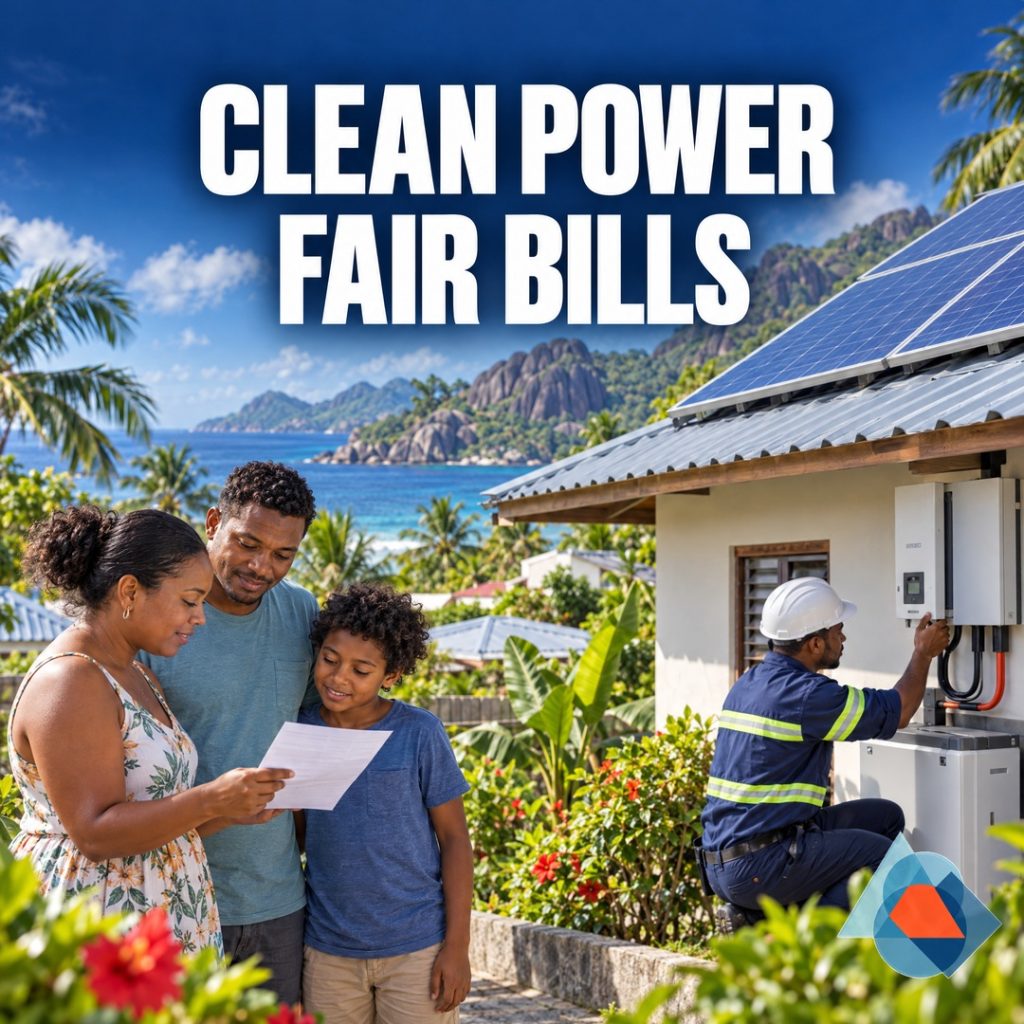
Image: original AI-generated editorial illustration for the Development and Resilience Research Monitor (DRRM). People and settings are illustrative, not a documentary photograph of a real household, institution or event.