
Public investment is only resilient if government can maintain it
October 23, 2026
Public investment is only resilient if government can maintain it
Seychelles’ public-investment question is not simply how much government appropriates for projects. It is whether a project is ready to build, affordable to operate, maintained after handover and still able to deliver its service when climate conditions worsen. The August 2026 Mid-Year Economic and Fiscal Outlook gives the issue a clear administrative signal: capital spending was SCR 181.1 million by the end of June against a year-to-date estimate of SCR 795.9 million, or 22.7% execution. That gap deserves investigation, but it does not prove that delayed projects are useless or that completed projects are effective.
Execution is a delivery measure, not a verdict on value
Capital budgets are plans and appropriations, not completed assets. Spending can lag because designs are incomplete, land or permits are unresolved, procurement is challenged, financing is delayed or works are deliberately sequenced. Conversely, a high spending rate can coexist with poor design, cost overruns or an asset that cannot be maintained. A balanced review should therefore publish project-level status: approved scope, readiness gate, procurement stage, contract value, payments, physical progress, revised completion date, risks and the service expected after completion.
The 2026 MYEFO reportedly lists deferred projects and revises the full-year capital estimate. The useful policy question is not whether every deferral is failure. It is whether the reasons are visible early enough for government to re-sequence the programme, protect essential maintenance and avoid carrying unrealistic estimates into the next budget. The National Development Strategy says a government agency was established to improve capital-project execution and advise on strategic infrastructure planning. Its value should be tested through published delivery data rather than assumed from its existence.
The asset cost begins after construction
A project’s initial price is only one part of its fiscal cost. Roads, drainage, schools, clinics, water systems and public buildings require staff, energy, inspections, spare parts, renewal and eventual replacement. If these costs are not included in appraisal, a project can look affordable at approval while creating a recurrent burden that crowds out other services.
A workable investment file should show the expected service life, maintenance schedule, annual operating cost, major-renewal dates, responsible agency and funding source. It should record the condition of the asset after handover and the consequences of postponing maintenance. This is not an argument for repairing everything forever. Some assets should be retired, redesigned or replaced when their whole-life cost is higher than a safer alternative. The decision requires evidence about condition and service, not only the age of the asset.
Publicly accessible sources reviewed for this article did not reveal a consolidated Seychelles asset register, national maintenance backlog or project-level lifecycle-cost schedule. That absence should be stated plainly. It is not proof that agencies do no maintenance. It means the public cannot yet test whether capital selection and recurrent budgets are joined up across the asset cycle.
Climate screening must change the design, not only the description
The World Bank’s 2026 Seychelles Country Climate and Development Report frames resilience as part of development policy. It reports that 90% of the population and key infrastructure are concentrated in coastal areas. That exposure makes location, drainage, elevation, corrosion, wave action, heat and emergency access relevant to many investments. A project can be useful today and still be poorly designed if it increases future service disruption or repair costs.
Climate models help identify risks and test design options. They do not create a government commitment or guarantee that a project will receive adaptation finance. The same caution applies to financing estimates. In its June 2026 Article IV consultation, the IMF said staff estimated that sustained public investment of around 5% of GDP a year would be needed to replenish the capital stock, support growth and provide climate-resilient infrastructure. The report also says projected capital expenditure was reduced to about 4% of GDP over the medium term. These are fiscal-policy judgments and modeled needs, not evidence that Seychelles has adopted a 5% commitment or that every additional project should proceed.
The practical test is whether climate screening is completed before approval and whether its findings affect the selected option. A drainage project may need a larger design standard, a road may need a different alignment, and a public building may need cooling, backup power or flood protection. The appraisal should show the baseline design, the risk tested, the incremental resilience cost and the expected reduction in downtime or damage. Where the evidence is uncertain, decision-makers should publish the uncertainty rather than convert a model into a precise promise.
A better capital programme protects maintenance
When fiscal space is tight, the choice is not always new construction versus no spending. It can be between preserving an existing service and adding capacity. The IMF describes a medium-term challenge of balancing recurrent spending, public investment and the public-debt anchor. That trade-off makes maintenance a fiscal decision, not an administrative afterthought.
A credible programme could ring-fence routine and preventive maintenance for critical assets, while requiring new proposals to identify their future operating cost. It could use readiness gates before an appropriation becomes a procurement target. It could publish quarterly delivery data and an annual review of whether completed projects achieved their intended service. It could also separate emergency repairs from planned maintenance so that repeated failures are visible rather than absorbed into an undifferentiated budget line.
These controls should not become a reason to delay urgent protection or essential services. They should make urgency more defensible. A transparent exception process can explain why a project is accelerated, what risk is being accepted and how maintenance will be funded.
The measure of success is dependable service
Seychelles needs infrastructure that remains usable, safe and financially manageable—not merely infrastructure that appears in an appropriation book. The 2026 capital-execution figure is a prompt to examine readiness, procurement and sequencing. The climate evidence is a prompt to examine location and design. The missing public asset and lifecycle data are a prompt to improve accountability.
A nonpartisan test would ask four questions of every major project: Was the need demonstrated? Was the full lifecycle cost funded? Was climate risk screened and reflected in design? After completion, did the asset deliver the promised service at the expected cost? Answering those questions would not eliminate uncertainty or delay. It would make choices more comparable, protect maintenance from being squeezed by new announcements and give residents a clearer basis for judging whether public investment is building resilience in practice.
Sources
Mid-Year Economic and Fiscal Outlook 2026 · Seychelles Country Climate and Development Report · Seychelles: 2026 Article IV Consultation, Fifth and Sixth Reviews · 2026 Budget Speech · Seychelles National Development Strategy 2024–2028 · Climate and Disaster Resilience Financing in Small Island Developing States
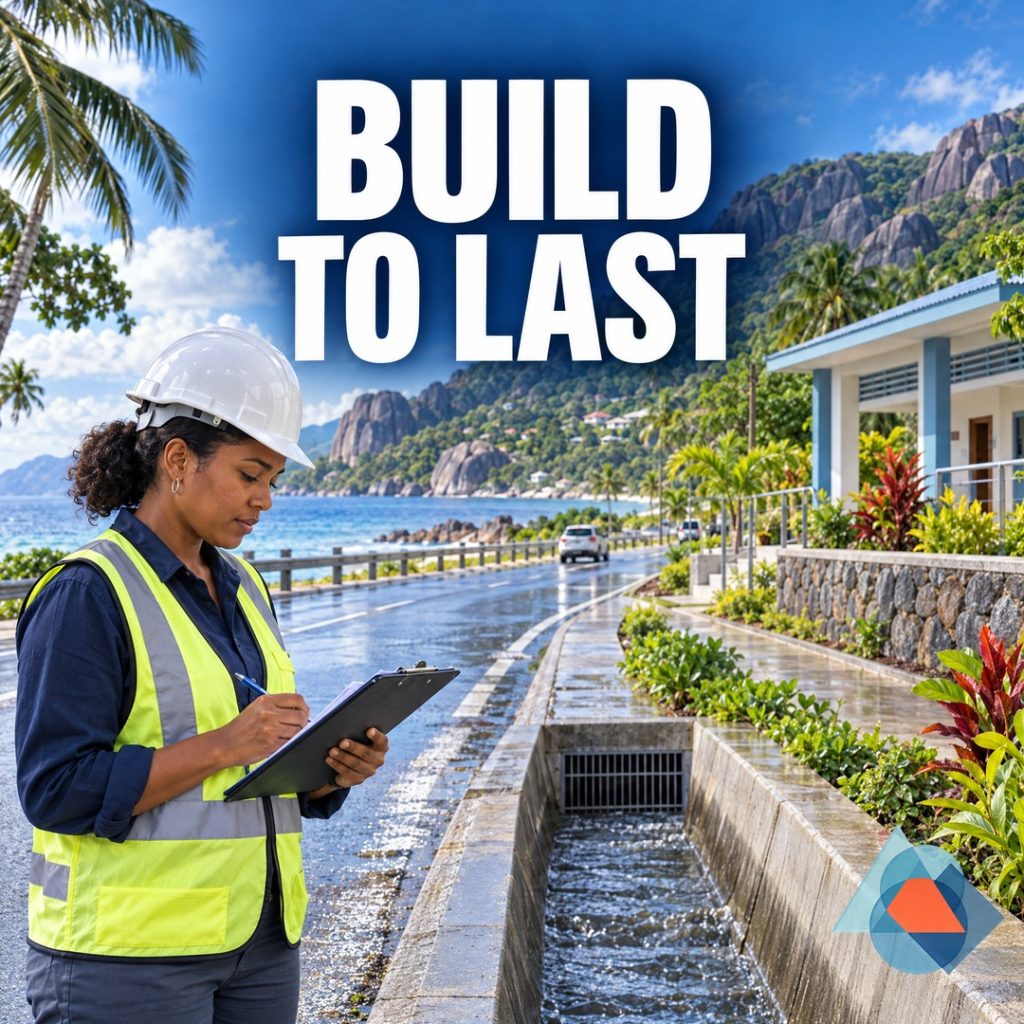
Image: original AI-generated editorial illustration for the Development and Resilience Research Monitor (DRRM). People and settings are illustrative, not a documentary photograph of a real household, institution or event.