
A warning is only useful if it helps people and institutions decide what to do in time. That is the practical meaning of Early Warnings for All (EW4All): not simply producing a forecast, but connecting knowledge, monitoring, communication and preparedness so that a hazardous event can lead to safer action.
What Seychelles is working towards
The global initiative aims for universal protection from hazardous weather, climate and related environmental events by the end of 2027. The target is a shared direction, not a claim that every place already has complete coverage. In Seychelles, a national validation workshop held in January 2025 was used to endorse a roadmap and action plan, identify responsibilities and establish coordination among national partners.
The Seychelles Meteorological Authority (SMA), the Disaster Risk Management Division (DRMD), the Department of Information Communications Technology and the Seychelles Communications Regulator Authority, together with the Red Cross Society of Seychelles, were identified in the 2025 account as key counterparts. The roadmap was intended to guide further investment, coordination, implementation and monitoring. It should therefore be read as a dated baseline for work in progress, not as evidence that the 2027 outcome has already been achieved.
Four connected parts of one system
First, disaster risk knowledge. Authorities and communities need to understand which hazards may occur, where people and assets are exposed, who may face greater difficulty receiving or acting on a warning, and what past events reveal. Risk knowledge makes a warning relevant to real places and real decisions.
Second, detection, observation, monitoring, analysis and forecasting. Measurements, models and professional analysis help identify a developing hazard and estimate how it may evolve. On 19 March 2026, SMA convened 56 participants to discuss impact-based forecasting and early-warning services, including high-resolution modelling over Seychelles and the Flash Flood Guidance System. The official account describes discussion and priority-setting, not proof that these capabilities were completed or deployed. The purpose is to explain not only what weather is expected, but what it could do.
Third, warning dissemination and communication. A technically sound message must reach people through channels they can access, understand and trust. Communication needs to account for language, disability, connectivity, location and the different ways institutions, businesses and households receive information.
Fourth, preparedness and response capabilities. People and organisations need plans, roles, resources and practice before a warning arrives. Without the ability to act, a message can be accurate and still fail to reduce harm.
Progress is not the same as completed coverage
Seychelles has continued to build pieces of this chain. The 2025 roadmap work documented gaps and capacity needs. UNDRR’s reporting on national risk-knowledge work highlighted the importance of inclusive, disaggregated information and the participation of groups that can otherwise be missed. From 20–22 January 2026, DRDM and UNDRR held national Disaster Tracking System training. UNDRR reports skills development using the Deltaresilience DTS Model and a country-specific roadmap/work plan. This strengthens the evidence base for preparedness; it is not a measure of completed warning coverage.
Those steps matter because end-to-end warning systems are maintained through cooperation. They also show why it would be misleading to say that EW4All coverage is complete. The public record reviewed for this article describes plans, workshops, technical strengthening and assessments. It does not provide evidence of universal, achieved coverage across Seychelles.
The regional agenda also remains unfinished. The Africa Early Warnings Forum in Addis Ababa on 2–4 September 2026 focused on scaling, financing and sustaining multi-hazard early-warning systems. Those regional priorities are relevant to Seychelles, but the forum is not a Seychelles-specific implementation scorecard.
The test is action
For DRRM, the central question is simple: when a credible warning is issued, can the right people receive it, understand the likely impact and take an appropriate step early enough? Answering that question requires all four pillars to work together, with attention to people who may be most exposed or least able to act without support.
That chain also needs ownership across sectors. A forecast office, risk managers, communications providers, local authorities, civil society and communities each contribute a different part of the result. Coordination is what allows those parts to meet at the point where a person has to make a decision.
This article is informational. It is not a live alert and does not replace current directions from the Seychelles Meteorological Authority or the Department of Risk and Disaster Management. For the latest conditions and official instructions, use those authorities’ current channels.
Sources
WMO: EW4All initiative and four pillars; SMA: January 2025 Seychelles roadmap baseline; UNDRR: inclusive risk knowledge in Seychelles; SMA: March 2026 impact-based forecasting workshop; UNDRR: January 2026 Disaster Tracking System training; UNDRR: Africa Early Warnings Forum 2026.
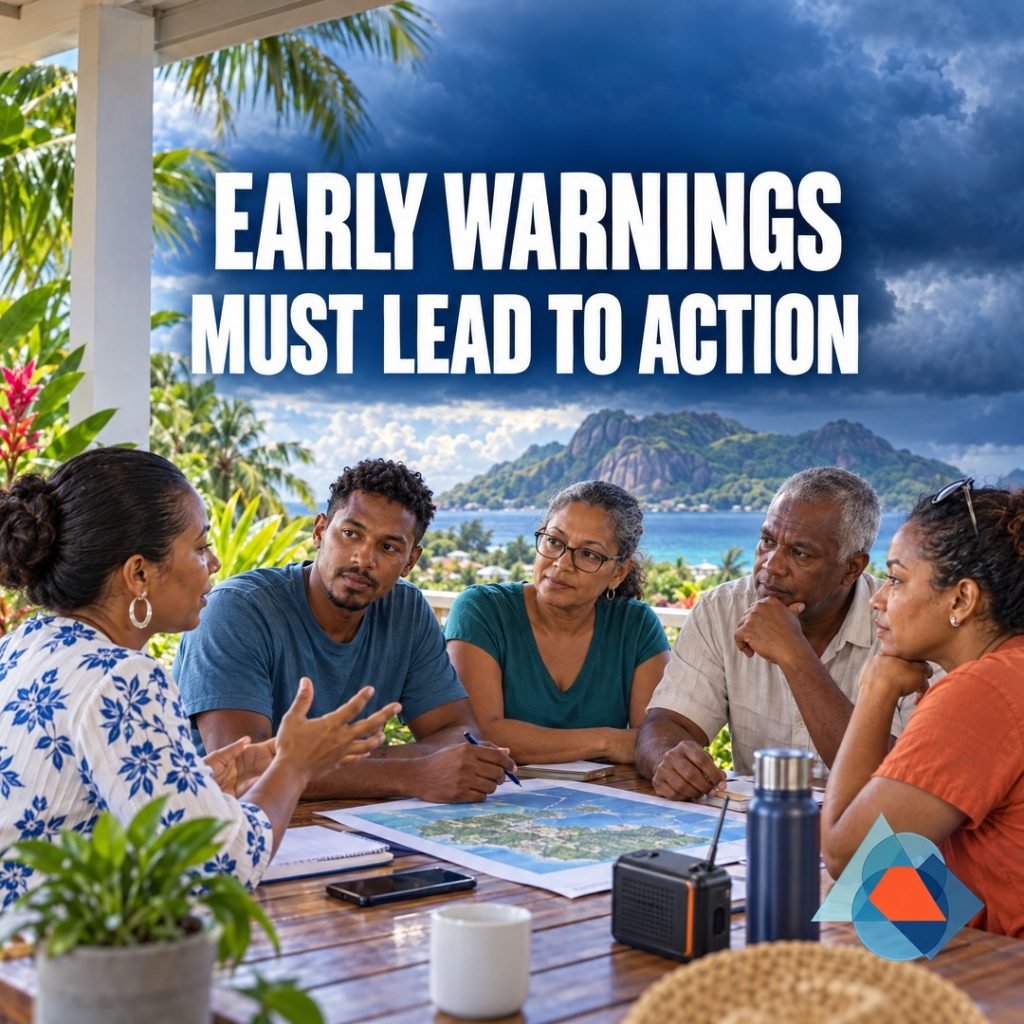
Image: original AI-generated editorial illustration for the Development and Resilience Research Monitor (DRRM). People and settings are illustrative, not a documentary photograph of a real household, institution or event.