
Food security in Seychelles: reduce exposure without assuming local production is always cheaper
October 23, 2026
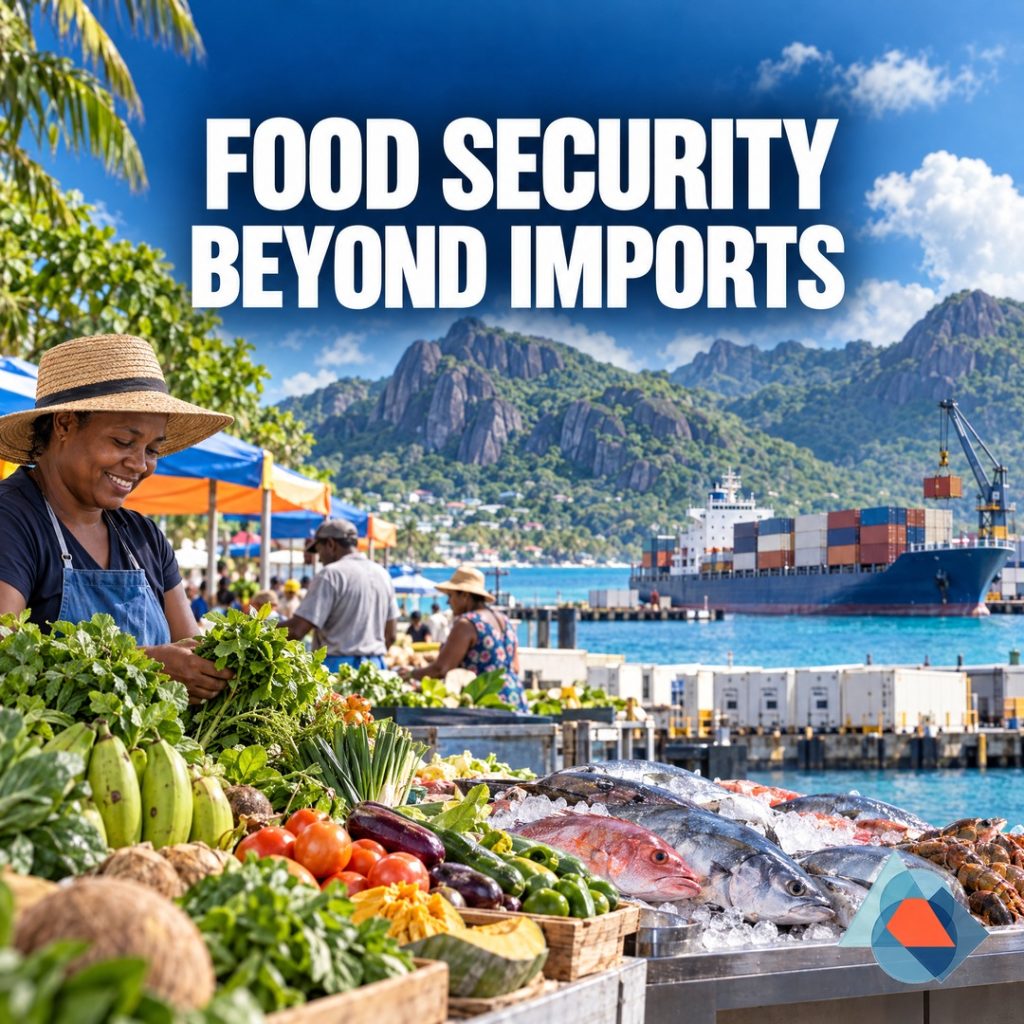
Food security in Seychelles: reduce exposure without assuming local production is always cheaper
Seychelles cannot make food security a choice between “import everything” and “produce everything at home”. The practical question is which risks should be managed through dependable imports, regional supply and storage, and which can be reduced at reasonable cost through local agriculture, fisheries and processing.
The latest trade bulletin gives a useful warning about how easily the issue can be misstated. In the first six months of 2026, the National Bureau of Statistics (NBS) recorded SCR 2.2595 billion of imports under “Food and Live Animals”, equal to 18.9% of total import value. The category was 4.6% lower in value than in the same period of 2025. But this is an import-value measure, not the share of food consumed in Seychelles. It is also not a calorie or nutrition measure. The category includes frozen tuna imported for processing by the tuna cannery. NBS merchandise trade bulletin
That distinction matters because the same bulletin records a large seafood trade in both directions. Fish and crustaceans made up 43.6% of the Food and Live Animals import category in January–June 2026. At the same time, canned tuna exports rose 14.2% year on year to SCR 1.6815 billion, while exports of fresh and frozen fish rose by 255%. Imports used in processing can support jobs and export earnings. Counting them as if they were all food bought for household consumption would exaggerate Seychelles’ direct dependence on imported meals.
The trade figures still show real exposure. Total imports reached SCR 11.9745 billion in the first half of 2026, up 17.5% from a year earlier. Food prices, shipping conditions, exchange rates, supplier disruptions and fuel costs can affect household access. The NBS figures are provisional and valued on a cost-insurance-freight basis, so they are a current signal, not a complete account of food availability or affordability.
What local production can and cannot do
The Ministry of Fisheries, Agriculture and Blue Economy describes domestic agriculture as a strategic part of food and nutrition security. Its current agriculture page also sets out the constraints: limited arable land, high production costs, dependence on imported inputs, climate exposure and vulnerability to external shocks. It identifies opportunities in vegetables, fruit, poultry, pork and other products, alongside protected agriculture, irrigation, biosecurity, post-harvest management, training and value-added processing. Ministry agriculture overview
Those statements support a policy direction, not a measured 2026 result. The public sources checked for this draft did not provide a complete, current series showing how much of each major food group is produced locally, how much is consumed, what is lost after harvest, or how retail prices compare with imported alternatives. The 2025 Voluntary National Review contains useful national baselines, but many of its indicators end in 2023 or earlier. They should be dated rather than presented as a 2026 production snapshot. Seychelles VNR 2025
The newly enacted Seychelles Agriculture Development Agency Act 2026 is an important institutional development. The Act’s stated purpose is to establish an agency and enhance national food security. It does not, by itself, demonstrate higher yields, lower costs or greater household access. Those outcomes will depend on implementation, the agency’s service offer, farmer participation, land and water access, input costs, biosecurity and whether public support reaches viable value chains. Agriculture Development Agency Act 2026
A cost test is essential. Local production may reduce exposure to a shipping interruption, but it can require imported seed, feed, fertiliser, equipment, electricity, water and packaging. The relevant comparison is the delivered cost, reliability, nutritional value, environmental cost and resilience benefit of each option—not the farm-gate price alone.
Fisheries require the same balanced treatment. Fish can provide food, income and export value, but stocks, access agreements, landing infrastructure and processing arrangements shape what is available to local consumers. The government’s FiTI material says Seychelles has improved public access to some fisheries information while significant gaps remain, including in agreements and other data required for full transparency. That is a reason to link food policy to resource management and public reporting, not to assume that a higher fish catch automatically means stronger food security. Seychelles FiTI reports
Regional supply is part of resilience
Import dependence is not the same as vulnerability to every supplier or route. Seychelles can reduce risk by tracking supplier concentration, contract reliability, shipping frequency, cold-chain capacity and the length of time essential stocks can cover. Regional trade can add options, but it is not a guarantee against disruption.
The 2024 COMESA–Indian Ocean Commission cooperation statement commits the organisations to work on regional trade, agriculture, a regional food-balance data platform, connectivity and a shipping line for COMESA island states. It also identifies Seychelles as one of the IOC countries that are COMESA members. These are cooperation priorities, not evidence that a new supply channel has already lowered Seychelles’ food costs. COMESA–IOC statement
Comparative SIDS evidence points in the same direction but must be used carefully. FAO’s SIDS publication reports that imports are a major source of available food in many island states and links food access to poverty, unemployment, prices, nutrition and disaster exposure. Its food-dependence figures are older, use a different denominator from the NBS import-value series, and should not be treated as a 2026 estimate for Seychelles. FAO, State of Food Security and Nutrition in Small Island Developing States
Measure the policy by access and resilience
A stronger food-security dashboard would report, by major food group, import value and quantity, supplier concentration, domestic output, seasonal availability, wholesale and retail prices, storage losses, nutrition indicators and the share of fish imported for processing or exported. It should also show whether support changes outcomes for households, farmers and fishers rather than simply counting projects, training places or tonnes produced.
The near-term policy mix is therefore likely to be selective. Keep essential imports reliable and diversified. Improve storage and cold-chain planning where the cost is justified. Use regional cooperation to widen sourcing options. Target local support at products where Seychelles has a credible resilience, nutrition or livelihood advantage. Publish comparable production and price data so that “import substitution” can be tested rather than assumed.
Food security is stronger when people can obtain safe, nutritious food at manageable cost through more than one dependable route. For Seychelles, resilience will come less from an absolute target for local production than from knowing which foods, suppliers, technologies and reserves provide the best protection for households when island logistics are stressed.
Sources
- NBS, *Merchandise Trade, 2026 Q2*, released 30 September 2026; data January–June and Q2 2026; provisional administrative trade data; food category includes frozen tuna for processing.
- Ministry of Fisheries, Agriculture and Blue Economy, Agriculture Department, current page accessed 24 October 2026; policy and constraint overview, not an output series.
- Seychelles Agriculture Development Agency Act 2026, 19 October 2026; enacted institutional mandate, not evidence of results.
- Seychelles Voluntary National Review 2025, October 2025; selected national indicators often ending 2023 or earlier.
- COMESA–IOC MOU signing statement, 15 April 2024; cooperation commitments, not realised trade outcomes.
- FAO, *State of Food Security and Nutrition in Small Island Developing States*, older comparative SIDS evidence; not a 2026 Seychelles food-balance estimate.
Development and Resilience Research Monitor (DRRM). This is independent policy analysis, not an official government alert or advice.
Image: original AI-generated editorial illustration for the Development and Resilience Research Monitor (DRRM). People and settings are illustrative, not a documentary photograph of a real household, institution or event.