
Does Seychelles Need More Expat Workers—and What Does That Mean for Unemployment?
October 23, 2026
Development and Resilience Research Monitor (DRRM) | 23 October 2026
Seychelles has a small labour market, a tourism-heavy economy and skills needs that can change faster than training pipelines. That makes expatriate, or non-Seychellois, workers visible in everyday economic debate. But two different questions are often mixed together: does an employer need a non-Seychellois worker for a particular post, and how many people in the resident labour force are unemployed? They are not the same statistic.
Start with the right definitions
The NBS Labour Force Survey Q2 2026, released on 30 September 2026 and covering April–June, reports an overall unemployment rate of 3.2%, a youth unemployment rate of 14.1% for people aged 15–24, and an employment-to-population ratio of 63.6% for the working-age population aged 15 and above (official NBS Q2 bulletin; NBS national summary). These indicators have different denominators: the unemployment rate is a share of the labour force, not of all residents or all working-age people. NBS classifies an unemployed person as not employed, actively looking for work or to start a business, and available to start. Its employment measure includes at least one hour of economic activity for pay, profit or family gain during the reference week, and temporary absence with job attachment. These quarterly survey estimates do not mean that every island, age group or occupation has the same experience.
“Expat” is a broad everyday label. For labour-market analysis, the closer administrative category is a non-Seychellois employee working under an approved post. The Immigration and Civil Status authority says a Gainful Occupation Permit (GOP) allows a person to work as an employee or self-employed person, and that all expatriate workers require one (Immigration and Civil Status: GOP). A permitted worker is therefore not automatically a permanent migrant, a new citizen, or a person counted as unemployed. Nor does a GOP total tell us whether the person is long-term resident, seasonal, or in a particular occupation.
The case for recruiting from abroad
The strongest case is targeted, not unlimited, recruitment. A hotel, hospital, construction firm or technology business may face a vacancy that local applicants cannot fill quickly. Bringing in a worker can keep a service open, transfer practical skills, support investment and avoid making a resident wait for an essential service. It can also help a small economy handle peaks in demand without asking a tiny resident workforce to do every job at once.
Seychelles’ rules already frame this as a test rather than an automatic entitlement. The Employment Department says the prospective employer normally must advertise locally and show that no local candidate is available. It also asks for a localisation or succession plan and, where relevant, a training plan (Employment Department labour-migration FAQ). That is a useful principle: approve a worker where there is a real, evidenced gap, while requiring the employer to build local capability.
The costs and the safeguards
There are genuine risks. If employers repeatedly recruit abroad for jobs that could be filled by residents after short training, local wages and career ladders may weaken. A high reliance on imported labour can also hide poor retention, unattractive schedules or underinvestment in vocational education. Housing, transport, health and school capacity can face additional demand. These effects cannot be inferred from a headline GOP count; they require occupation-level data, wages, vacancies and retention evidence.
Workers themselves need protection. The official FAQ says a non-Seychellois worker should work only in the post and for the employer approved, and that contracts must be attested. It sets penalties for employing people without a valid permit. Enforcement should therefore cover recruitment fees, pay, working time, accommodation and the ability to report abuse—not only whether a document exists. Good compliance protects local workers from unfair competition and migrant workers from exploitation.
What unemployment does—and does not—tell us
A low national unemployment rate can coexist with youth unemployment, skills mismatch, long job searches or people leaving the labour force. Conversely, a rise in non-Seychellois employment does not prove that residents were displaced. Jobs can be complementary: a foreign chef, nurse or engineer may allow a wider operation to hire more residents. The test is empirical. NBS and policymakers should publish consistent quarterly series by citizenship or nationality, occupation, industry, age and sex, while clearly labelling survey estimates and administrative counts. They should also show vacancies, permits granted and renewed, and outcomes of localisation plans.
The balanced answer is “needed in some places, conditional everywhere.” Seychelles should welcome skills that are genuinely scarce, time-limit approvals where appropriate, require credible succession plans, and invest in training and better job quality for residents. It should not use the unemployment rate as a slogan for or against migration. The honest policy question is whether each approved post adds capability and fair employment without weakening the institutions that prepare Seychellois workers for the next one.
References
NBS Q2 2026 Labour Force Survey bulletin; NBS national summary data; Immigration and Civil Status GOP guidance; Employment Department labour-migration FAQ. Q2 figures cover April–June 2026; the unemployment rate is a labour-force estimate, not a foreign-worker or migrant count.
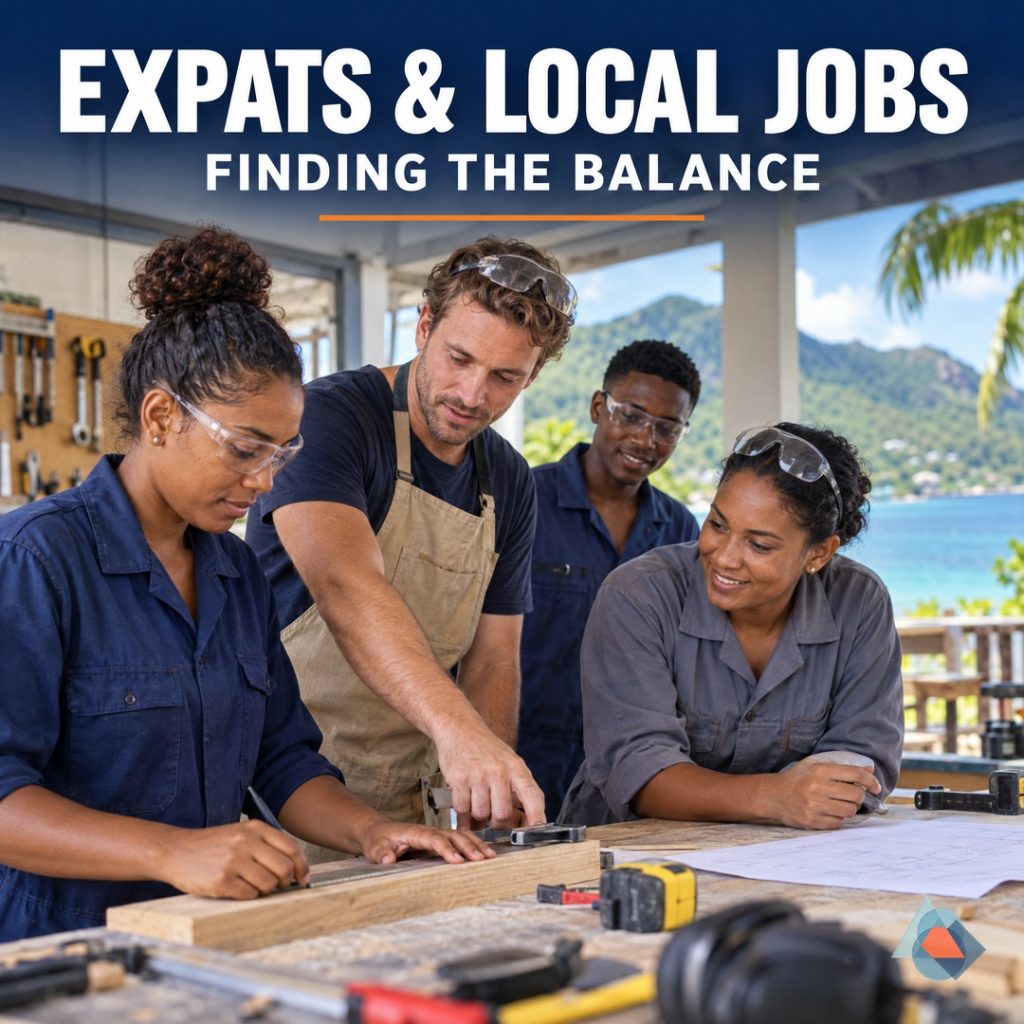
Image: original AI-generated editorial illustration for DRRM. People and settings are illustrative, not a documentary photograph of a real household, workplace or event.