
When landfill space becomes a public cost: making Seychelles’ waste system measurable
October 23, 2026
When landfill space becomes a public cost: making Seychelles’ waste system measurable
Seychelles’ waste debate has moved from a long-term planning question to a near-term operating test. Providence, Mahé’s principal disposal site, was described as almost at maximum capacity in an August 2026 report, while the World Bank’s March project update said careful operation over the next 12 to 18 months was critical. That is a reason to improve measurement and diversion quickly, not a reason to assume that any single technology or fee will solve the problem.
The first gap is knowing what is entering the system
A credible waste policy needs one material-flow account: how much waste arrives, from which island and source, in which stream, and at what cost. The latest Landscape and Waste Management Agency (LWMA) annual report provides a warning about the current evidence base. It says the Providence weighbridge was non-operational in 2024, and that annual data for its organic-waste processing and recovery targets were unavailable because of the breakdown. The report records a new weighbridge being procured and repair work under way, but a procurement step is not the same as a functioning, published time series.
This matters because several figures in public discussion use different scopes. The 2026 Seychelles News Agency report, citing the environment ministry and World Bank project documents, says the country generates around 90,000 tonnes of waste annually and that only around 1% is recycled. Those are useful signals of pressure, but the article does not establish a complete 2026 weighbridge series. “Municipal waste”, waste received at Providence, and all waste generated across Mahé, Praslin and La Digue are not interchangeable denominators. The government should publish the definition, period, islands, excluded streams and measurement method beside every headline number.
The old baseline also needs to stay old. The 2025 Voluntary National Review and the 2020–2035 Solid Waste Masterplan can show trends and planning assumptions, but the masterplan’s scenarios are not observed performance. A current dashboard should show monthly receipts by site, contamination, diversion, exports, fires, remaining airspace and operating expenditure. It should also show the cost per tonne for collection, transfer, disposal, recovery and export, separated where possible between fixed and variable costs.
Providence makes prevention and capacity two parts of one policy
The World Bank’s March 2026 implementation report rates the solid-waste project’s progress as satisfactory, but it also says that physical works had not started by 28 February. It identifies three components: strengthening operations and increasing disposal capacity at Providence; institutional strengthening and circularity; and project management. The report says Providence had almost reached maximum capacity and highlights airspace allocation, slope-failure and fire risks, and green-waste diversion as immediate priorities.
This is not an argument against the planned landfill investment. A safe, properly operated disposal cell can be necessary public infrastructure. It is an argument against treating added capacity as the whole solution. If recyclable or compostable material continues to enter the landfill, a new cell can postpone the constraint while preserving the cost drivers. The project’s own indicators include a planned reduction in waste going to landfill through minimisation and diversion, a reduction in LWMA operating costs from more efficient procedures, and improved services for people on Mahé. Those outcomes should be reported alongside construction milestones.
The cost of delay is not limited to land. Fires, leachate, slope instability and emergency handling can impose environmental and public-health risks. Conversely, hurried diversion without reliable markets, quality controls or safe processing can leave households and businesses paying for a system that produces contaminated, unsaleable material. The right comparison is therefore whole-system cost and risk, not the gate price of one facility.
Deposit returns show what a targeted incentive can do
There is already a strong local example of targeted diversion. UNDP reported in October 2025 that Seychelles’ national deposit-refund scheme for PET bottles had achieved a 90% collection rate and diverted more than 400 million bottles from landfills and the natural environment. The figures come from the UNDP-supported case study and describe the scheme’s reported results; they are not a recycling rate for all waste.
That distinction is important. A deposit can work well where the material is recognisable, the refund is meaningful, return points are accessible and a buyer or exporter exists. It does not automatically solve food waste, mixed packaging, construction debris, tyres or hazardous material. Expanding the model should therefore begin with a transparent account of deposits collected, refunds paid, bottles returned, rejected material and net administrative cost. Access also matters: return points and redemption rules should not make the system easier for hotels or central businesses than for households on other islands.
The policy mix should make the payer and beneficiary visible
Source separation can reduce contamination, but it shifts some work to households, businesses and collection crews. Producer responsibility can place more of the cost of packaging on importers and producers, but the rules need a clear definition of obligated products, reporting, free-riding controls and the use of fees. User charges can encourage reduction, yet a flat charge may be unfair to households that cannot avoid packaging or have limited storage. Public funding remains justified for public-health functions, but it should be linked to service standards and published costs.
The most practical next step is a staged account rather than a sweeping promise. First, restore and audit weighbridge coverage at all main disposal sites. Second, publish a common waste taxonomy and monthly data. Third, cost the current system by activity and stream. Fourth, test separation and organics diversion where collection and end markets can be monitored. Finally, use the results to decide whether deposits, producer responsibility, user charges or a combination delivers the greatest reduction in landfill dependence per rupee, with protections for households and small businesses.
Seychelles does not need to choose between a safer landfill and a circular economy. It needs to stop measuring them as unrelated projects. The immediate test is whether public agencies can show, stream by stream, what is being avoided, recovered, disposed of and paid for. Until that denominator is stable, claims about progress will remain difficult to compare—and decisions about the next rupee will be harder to defend.
Sources
Seychelles' main landfill almost at maximum capacity as waste pressure mounts · Seychelles Solid Waste Management Project: Implementation Status & Results Report · LWMA Annual Report 2024 · Seychelles’ Success in Beating Plastic Pollution Showcased at Africa’s Circular Economy Annual Meeting · Government seeks World Bank assistance for Seychelles Solid Waste Project · Solid Waste Masterplan for Seychelles 2020–2035
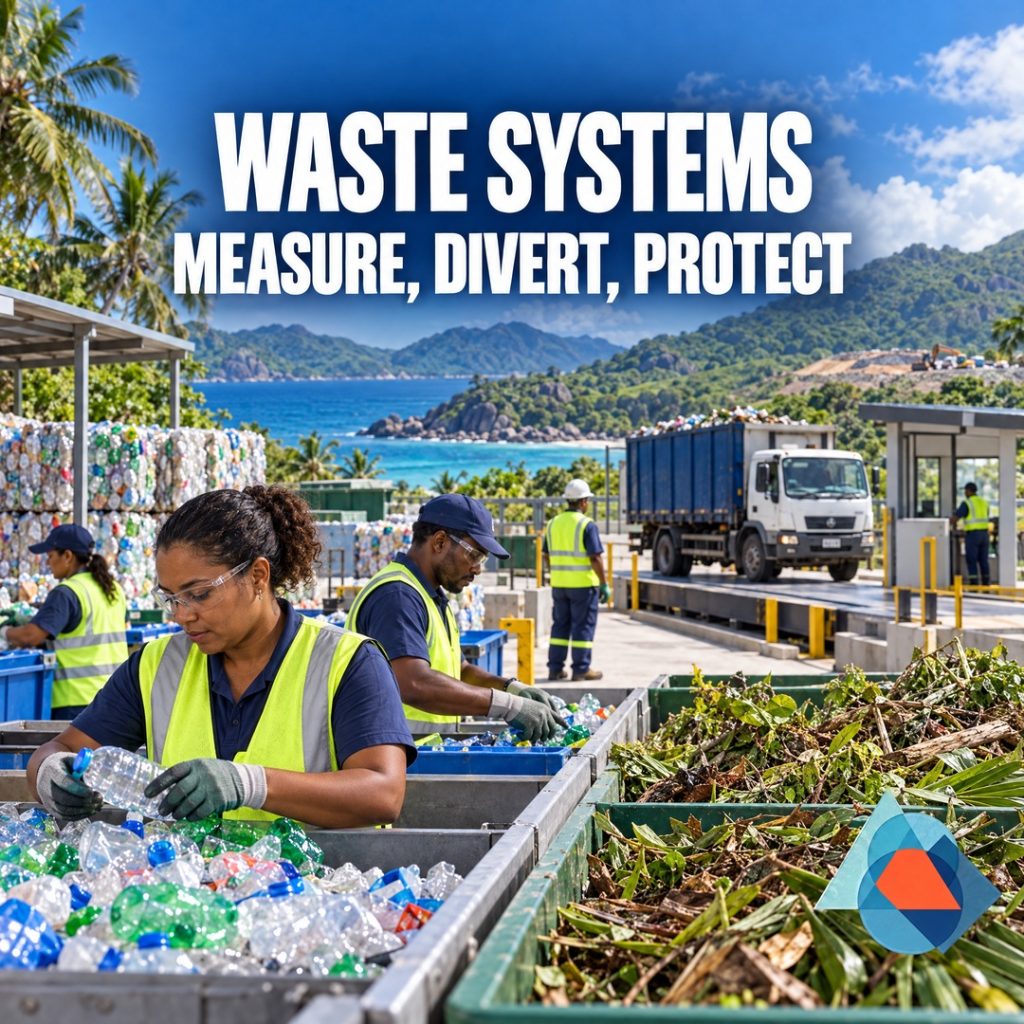
Image: original AI-generated editorial illustration for the Development and Resilience Research Monitor (DRRM). People and settings are illustrative, not a documentary photograph of a real household, institution or event.