
Water Security in Seychelles: Reliability and Whole-Life Costs Beyond New Capacity
October 23, 2026
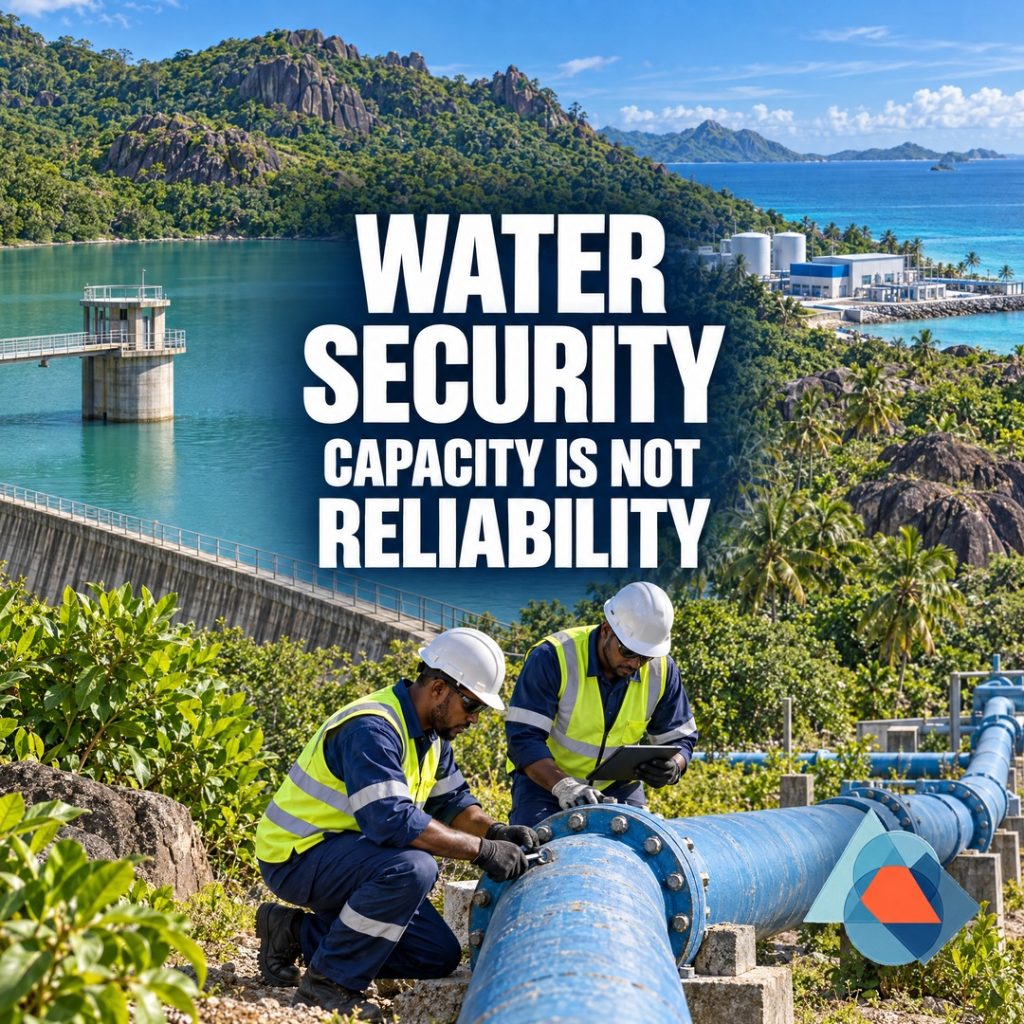
Reliable water is more than enough water on paper
Water security is often discussed as a question of capacity: how much water can a utility produce or store? For households, reliability is more practical. Can water be delivered when needed, at acceptable quality, through a network that can be repaired and powered over its full life? Seychelles has made clear investments in dams, desalination and reservoirs. The next policy test is to compare those supply options with leakage control, demand management and the recurring cost of keeping the system working.
The latest national baseline shows a diversified system
The 2025 Voluntary National Review, using Public Utilities Corporation data for 2023, reports total potable-water production of 16,029,760 cubic metres. Surface water supplied 11,754,260 cubic metres and desalination 4,275,500 cubic metres, so desalination accounted for 27% of production. The island mix differed: desalination was 25% of production on Mahé, 31% on Praslin and 57% on La Digue.
That mix reduces dependence on rainfall alone, but desalination is not a free backup. It requires electricity, treatment equipment, skilled operation and replacement investment. The VNR’s 2023 numbers show how much the system depends on a combination of sources, not a single project. They do not, however, show the unit cost of water by source or the cost paid by different users.
Storage helps, but storage is not the same as service
The VNR reports that the La Gogue Dam was raised by six metres, increasing storage capacity by 60%. It says the dam’s water level stayed above 65% throughout 2024 and often exceeded 90%. The report also says Seychelles occasionally experiences water restrictions, especially in the dry season. These facts can coexist: a reservoir can be well supplied while pressure, treatment, pumping, local storage or network conditions still affect a household’s tap.
That is why dependable service needs its own measures. A useful public series would show interruptions by area, hours of supply, pressure complaints, rationing days, water-quality incidents and the time taken to repair failures. The VNR provides a national infrastructure baseline, but it does not provide that 2025 or 2026 reliability picture.
Leakage is a supply option too
Non-revenue water is water entering the system that is not billed or otherwise accounted for. It can include physical leaks, inaccurate meters and unauthorised use. The VNR reports an annual average volume of 3,641,930 cubic metres in 2023, down from 5,185,000 cubic metres in 2015 but above 3,168,292 cubic metres in 2020. The long-term direction is positive, while the rise from 2020 shows why progress should not be treated as finished.
Reducing losses can create usable supply without building a new plant. But it also costs money: pipes must be surveyed, pressure managed, meters maintained and roads reopened for repairs. The relevant comparison is therefore not “leakage good, desalination bad.” It is the whole-life cost of each option, including energy, chemicals, labour, maintenance, finance, replacement and the value of water that becomes available.
Climate and island geography raise the stakes
The World Bank’s 2026 Country Climate and Development Report treats water as one of six priority areas for resilient development and places Seychelles’ water system within wider risks from climate variability and concentrated infrastructure. A drought can reduce surface-water yields. A storm, power interruption or landslide can damage access to a network. A coastal system also has to consider long-term exposure, even when today’s output is adequate.
The 2025 UN study on water and sanitation in Small Island Developing States is useful as context, not as a Seychelles average. It highlights major data gaps across SIDS and points to the high investment and operating demands of desalination and wastewater treatment. Its recommendations include better monitoring, integrated water-resources management and reducing non-revenue water. Seychelles should borrow the questions, not import a generic benchmark.
What households and decision-makers need to see
A serious water-security account would publish annual production and source mix alongside energy use, unit operating cost, capital repayment, maintenance spending and asset condition. It would separate rainfall-related shortages from network failures. It would report reliability by island and, where possible, by neighbourhood. It would also show how tariffs, subsidies or public transfers distribute costs between households, tourism and the state.
Demand management belongs in the same account. Metering, leak repairs on private properties, rainwater capture where safe, water-efficient fixtures and clear drought rules can reduce peak pressure. Wastewater treatment and reuse may eventually add resilience, but only if public-health safeguards and lifecycle costs are demonstrated. These measures should be assessed, not assumed to be cheaper.
Seychelles’ evidence shows real progress: more storage, a meaningful desalination share and lower non-revenue water than in 2015. It also shows why reliability cannot be inferred from production alone. The next step is not simply to add capacity. It is to publish the service, energy and cost data needed to decide which combination delivers dependable water at a sustainable whole-life cost.
Sources
Seychelles Voluntary National Review 2025; PUC Annual Report 2023; World Bank Seychelles Country Climate and Development Report; UN SIDS Final Study Report; 2026 Budget Speech.
Image: original AI-generated editorial illustration for the Development and Resilience Research Monitor (DRRM). People and settings are illustrative, not a documentary photograph of a real household, institution or event.