
Youth unemployment is a warning signal, not a diagnosis of skills mismatch
October 23, 2026
Youth unemployment is a warning signal, not a diagnosis of skills mismatch
Seychelles’ latest labour-market release raises a clear policy question. In the second quarter of 2026, the unemployment rate for people aged 15–24 was 14.1%, up from 9.7% in the same quarter of 2025. The overall unemployment rate was 3.2%. NBS Labour Force Survey, Q2 2026
The youth figure deserves attention, but it does not prove that young people lack the skills employers need. The unemployment rate is calculated among young people in the labour force, not among all young people. In Q2 2026, 52.7% of 15–24-year-olds were outside the labour force, 40.6% were employed and 6.7% were unemployed as shares of the youth working-age population. These are different measures. A rise in unemployment can reflect job-search conditions, participation changes, wages, transport, housing, working conditions, migration or employer recruitment practices as well as education and training.
The NBS bulletin also shows why the transition needs to be followed beyond a single rate. Overall labour-force participation rose from 63.3% in Q2 2025 to 65.7% in Q2 2026, while the employment-to-population ratio rose from 61.9% to 63.6%. Among 15–24-year-olds, the employment-to-population ratio rose from 38.3% to 40.6%. The labour market is therefore not moving in one direction on every measure. The current release provides age, education, occupation and industry distributions, but it does not by itself match graduates’ fields of study to vacancies, wages, first-job timing or retention.
What the new evidence adds
The World Bank’s 2026 Seychelles Country Growth and Jobs Report provides a more specific account of the school-to-work problem. It says employers report persistent skills shortages and links these to weaknesses in learning and school-to-work transitions. It also identifies learning gaps, inadequate academic support and a weakness in the General Education and Skills Development Pathway, or GESDP, the non-academic upper-secondary track. The report says the GESDP certificate is not recognised as a sufficient entry qualification for professional centres under the national skills qualification framework. World Bank, Seychelles Country Growth and Jobs Report
These are important findings, but they are analysis and recommendations, not a new NBS series proving the size of a skills mismatch. The report’s argument is strongest where it identifies a concrete institutional friction: a student can complete a pathway without holding the qualification needed to enter further training. That is different from saying every unemployed young person is under-skilled, or that more courses alone will solve the problem.
The report recommends clearer pathways from GESDP into direct employment or further training, better integration of skills training and professional centres, and reform of the national qualification framework so certificates are recognised across institutions. It also calls for stronger learning support and early identification of young people at risk of disengagement. Those proposals imply measurable tests: how many students move into work or training, how long the transition takes, whether certificates are accepted, and whether participants remain in work.
The report also flags digital change. Its analysis estimates that 17% of jobs in Seychelles are at risk of displacement by artificial intelligence, while 22% could become more productive with AI. These are modelled estimates, not observed job losses or a forecast of net employment. The report says most of the jobs it classifies as at risk are held by Seychellois workers and identifies customer-service and business-administration occupations among the largest groups. This strengthens the case for adaptable digital skills, but it does not justify directing every young person into one occupation or treating technology exposure as inevitable unemployment.
A new careers agency, and the test of implementation
The Careers and Further Education Agency Act 2026 creates a current institutional development relevant to this transition. Its purpose is to establish an agency covering careers and further education functions. The Act creates a framework for coordination, but its enactment is not evidence that guidance, scholarships, training choices or workforce planning have already improved. Careers and Further Education Agency Act 2026
Implementation should be judged by whether a young person can see a usable route from school to a suitable next step. That means current information on course entry requirements, recognised qualifications, vacancies, expected wages, work-based learning and progression. It also means counselling that reaches students before they leave school, including those who are not on an academic track. Employers should be able to describe the tasks and competencies they need without using vague claims about “work readiness”.
The 2025 Voluntary National Review remains useful for historical context on education, youth and NEET indicators, but many of its series end in 2023 or earlier. NEET means not in education, employment or training. It is not the same as unemployment because it can include people outside the labour force, and it should not be compared with the NBS unemployment rate without checking the year and denominator. Seychelles VNR 2025
Measure outcomes, not enrolment alone
A credible school-to-work dashboard would connect administrative records while protecting personal data. It would report school completion and pathway, field of study, qualification recognition, applications and placements, time to first job, earnings, contract type, retention after six and twelve months, and transitions into further training. Results should be separated by sex, age, disability, island and socioeconomic background where sample sizes permit.
Vacancy data also need care. A vacancy is not necessarily a shortage. It may reflect low pay, difficult hours, limited transport, seasonal demand, high turnover or a preference for experienced or foreign workers. A training place is not an employment outcome. A fall in youth unemployment could reflect people leaving the labour force rather than finding stable work. These distinctions should be built into evaluation before programmes are expanded.
The policy choice is therefore not simply to increase vocational enrolment or blame schools for a weak transition. Seychelles needs a connected chain: stronger foundational learning, recognised pathways, practical career guidance, employer-linked training and support for the non-educational barriers that affect job search. The 2026 youth unemployment rate is a reason to improve that chain urgently. It is not, on its own, proof of a single skills problem.
Sources
- NBS, *Labour Force Survey, Quarter 2 2026*, released 2026; data April–June 2026; labour-force denominator and household-survey coverage apply.
- World Bank, *Seychelles Country Growth and Jobs Report*, 2026; analytical report and recommendations, not an NBS labour-market series.
- Careers and Further Education Agency Act 2026, April 2026; institutional framework, not evidence of delivery outcomes.
- Seychelles National Development Strategy 2024–2028, August 2025; policy priorities, not a current outcome series.
- Seychelles Voluntary National Review 2025, October 2025; selected education, youth and NEET baselines often ending in 2023 or earlier.
Development and Resilience Research Monitor (DRRM). This is independent policy analysis, not an official government alert or advice.
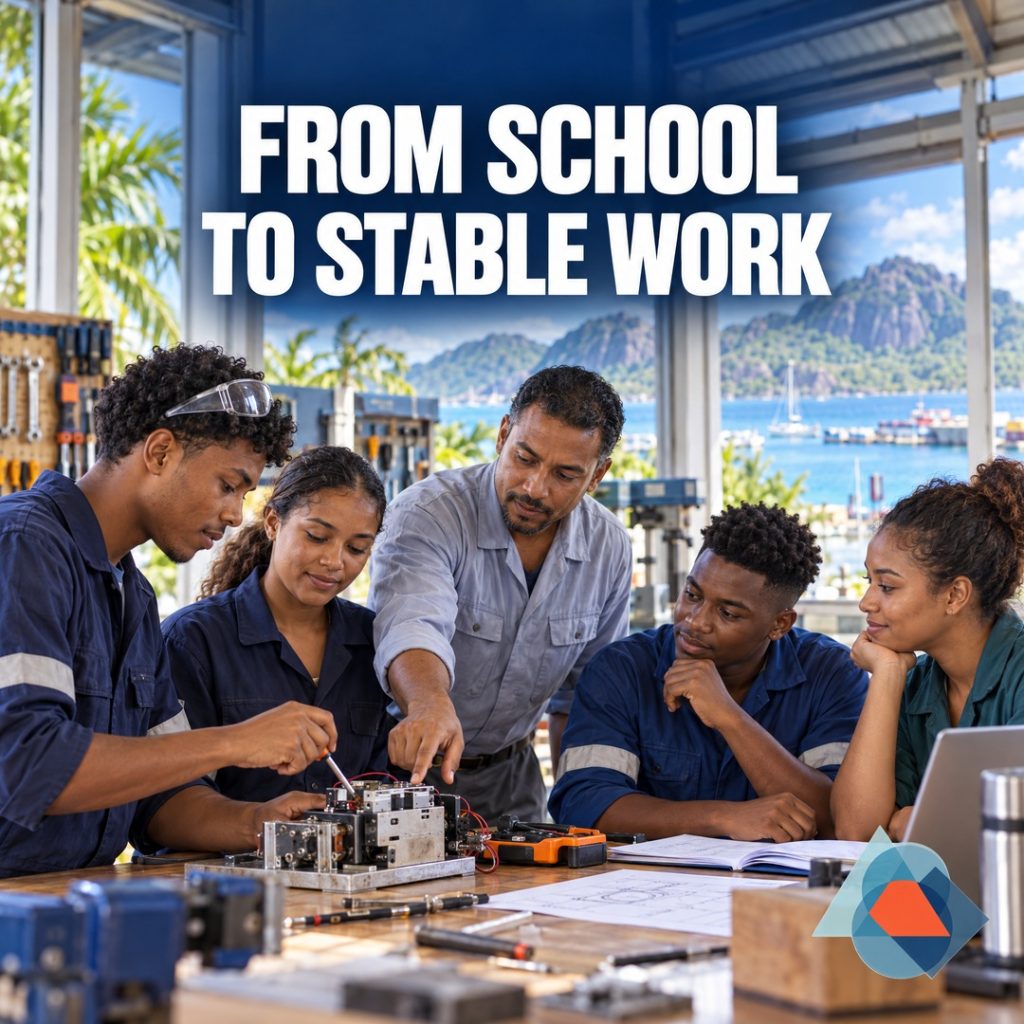
Image: original AI-generated editorial illustration for the Development and Resilience Research Monitor (DRRM). People and settings are illustrative, not a documentary photograph of a real household, institution or event.